

Self Defense Neuroscience: Why Contemporary Threat Neuroscience Does Not Support Flinch-Based Tactical Geometry
Authors Note on Practical Implications for Self-Defense Training
Understanding how the brain and body respond to threat has direct implications for how self-defense should be trained. Many commercial systems assume that instinctive reactions, particularly the startle reflex, can be shaped into reliable defensive techniques. However, contemporary neuroscience shows that reflexive responses are not structured, consistent, or strategically organized. Instead, behavior under threat is influenced by physiological state, prior conditioning, environmental context, and cognitive processing under stress.
This means that effective self-defense education cannot rely on instinct alone. It must be aligned with contemporary research and account for how autonomic state constrains action, how freeze responses and hesitation emerge, and how motor skills must be learned and reinforced under realistic conditions. Training that aligns with threat neuroscience focuses on improving perception, decision-making, and motor execution within these constraints versus assuming reflexive movements will produce effective outcomes.
How to Use This Paper
This paper draws on research from neuroscience, psychophysiology, and motor learning and explains why people freeze during an attack, how the brain processes threat, and what effective self-defense training should account for based on modern neuroscience. To make these concepts more accessible and to support practical application in self-defense training, key terms are defined below. These definitions are intended to provide understanding and context as you move through the model and understand how threat response translates into real-world behavior.
Introduction
Commercial self-defense systems frequently assert that the human startle response (commonly termed “the flinch”) contains embedded tactical geometry which can be converted into structured defensive positioning under threat. This paper evaluates that claim against contemporary findings in fear conditioning, startle modulation, defensive cascade models, freeze behavior, tonic immobility, and autonomic state gating.
Drawing on empirical research in psychophysiology and affective neuroscience, this paper argues that the human startle reflex is a subcortical, non-strategic defensive response versus an embedded tactical architecture (Sevenster et al., 2014).
Threat-induced responses are rapid and automatic, but effective motor organization, spatial positioning, and control are dependent on learned motor patterns and are not reliably produced by untrained reflexive movement (Schmidt & Lee, 2015). Contemporary defensive neuroscience further demonstrates that sympathetic arousal does not guarantee immediate motor activation and that behavioral responses unfold within phase-dependent defensive cascades versus through singular mobilization events (Bradley et al., 2017).
Within these cascades, freezing, tonic immobility, dissociation, and compliance responses are common and adaptive modes of responding to threat, particularly under conditions of uncertainty or perceived inescapability (Bradley et al., 2017). The compression of startle reflex, threat appraisal, autonomic shift, and motor selection into a unified flinch-to-fight narrative is therefore not supported by contemporary evidence.
In response, we propose a physiology-aligned Threat Processing Sequence model that explicitly separates reflexive activation from strategic motor learning and integrates freeze probability, contextual modulation, dissociative variability, and state-gated motor selection into a coherent framework for civilian defensive training.
Key Definitions
Startle Reflex
A rapid, involuntary response of the body triggered by sudden or threatening stimuli. It is mediated by brainstem and amygdala circuitry and functions as a protective contraction, not as a structured or strategic movement pattern.
Tactical Geometry
A proposed concept in some self-defense systems suggesting that instinctive movements (such as the flinch) contain pre-structured spatial positioning that can be converted into effective defensive technique. Contemporary evidence does not support the existence of consistent or reliable tactical geometry within reflexive responses.
Autonomic State Gating
The process by which the autonomic nervous system (sympathetic, parasympathetic, or shutdown states) constrains and regulates the availability of motor actions. Certain behaviors are enabled or inhibited depending on the individual’s physiological state under threat.
State-Dependent Constraints
Limitations on perception, decision-making, and motor output that arise from the individual’s current physiological and psychological state. These constraints influence what actions are available, likely, or even possible in a given moment.
Motor Selection
The process by which the brain selects a behavioral response from available action options. Motor selection is influenced by autonomic state, prior learning, environmental context, and perceived threat, rather than being determined by reflex alone.
Sympathetic Autonomic State
A physiological state associated with arousal and mobilization, commonly linked to increased heart rate, heightened alertness, and preparation for action. While often associated with “fight or flight,” it does not guarantee effective or organized movement.
Motor-Dependent Constraints
Limitations on action that arise from an individual’s level of motor skill acquisition, coordination, and training. Effective defensive behavior depends on learned motor patterns rather than reflexive movement alone.
Cognitive Load
The amount of mental processing required at a given moment. Under threat, high cognitive load can impair decision-making, slow reaction time, and reduce the ability to select effective actions.
Defensive Cascade
A phase-based model of threat response describing how behavior progresses through stages such as vigilance, freezing, mobilization, tonic immobility, and shutdown, depending on threat imminence and perceived controllability.
Tonic Immobility
An involuntary state of motor inhibition or “shutdown” that can occur under extreme threat, characterized by reduced movement, decreased responsiveness, and limited ability to initiate action despite awareness.
The Startle Reflex Is Not Tactical Architecture
Startle Reflex Mechanisms
Sevenster et al. (2014) demonstrate that fear-potentiated startle can occur independently of conscious discrimination between threat and safety cues. In their conditioning paradigm, skin conductance responses depended on contingency awareness, whereas startle potentiation did not, leading the authors to conclude that skin conductance responses, but not startle conditioning, require conscious discriminative fear learning (Sevenster et al., 2014).
This dissociation indicates that defensive responding is expressed through partially independent channels and that reflexive activation does not necessarily reflect structured cognitive appraisal or strategic motor planning.
Startle is characterized as an amygdala-initiated defensive reflex reflecting subcortical defense circuitry and mediated at the brainstem level (Sevenster et al., 2014). It is rapid in onset, typically occurring within approximately 30 to 50 milliseconds, non-volitional, and subcortically organized. Its function is protective contraction versus structured tactical deployment.
Misinterpretation of Reflexive Movement in Training
Commercial self defense training systems that interpret raised arms during startle as a pre-encoded guard structure conflate reflexive contraction with strategic motor positioning. Because startle potentiation can occur in the absence of conscious contingency, learning reflexive output cannot be equated with organized motor planning or spatially structured defensive geometry (Sevenster et al., 2014).
Contextual Modulation of Startle
Moreover, startle magnitude is contextually modulated versus morphologically invariant. Grasser et al. (2023) demonstrate that fear-potentiated startle is significantly greater during conditioned threat cues compared to safety cues, reflecting learned threat gating. Ferry et al. (2023) further show that startle amplitude varies as a function of threat predictability, with heightened defensive responding under unpredictable conditions. These findings indicate that startle expression is state-dependent and sensitive to conditioning history, contextual uncertainty, and anticipatory processing.
There is no empirical demonstration of a universal flinch morphology, cross-population reliability of arm positioning, consistent spatial geometry across contexts, or stability across varied threat modalities. Reflexive activation may involve protective elevation of the upper limbs, but neither its amplitude nor its morphology has been shown to encode reliable, transferable tactical architecture. Startle indexes defensive activation; it does not constitute structured tactical geometry.
Summary:
The startle reflex (startle response) is a fast, automatic reaction controlled by the brain’s survival systems. While it may raise the arms or cause protective movement, it does not contain built-in fighting technique or structured positioning. Research shows that startle responses can occur without conscious awareness and vary depending on context. This means the “flinch” is not a reliable or consistent foundation for self-defense training.
Sympathetic Arousal ≠ Immediate Action
Commercial doctrine often assumes that sympathetic activation produces aggressive motor engagement. Contemporary defensive neuroscience does not support this assumption. The defensive cascade model describes threat responding as a phase-based progression versus a singular mobilization event (Bradley et al., 2017; Kozlowska et al., 2015).
Defensive states shift across threat imminence and perceived controllability, moving through vigilance, freezing, mobilization, tonic immobility, and, in extreme conditions, collapsed immobility (Kozlowska et al., 2015). Importantly, freezing is not a failure of activation, rather a biologically organized defensive mode characterized by heart rate deceleration, reduced movement, and enhanced sensory intake (Bradley et al., 2017; Kozlowska et al., 2015). In this state, sympathetic and parasympathetic systems may co-activate, producing motor inhibition versus forward aggression (Kozlowska et al., 2015).
Ferry et al. (2023) demonstrate that startle magnitude indexes defensive motivation under conditions of uncertainty but do not indicate that such activation guarantees organized forward motor behavior. Defensive activation is state-sensitive and modulated by threat predictability. Similarly, Grasser et al. (2023) show that fear-potentiated startle is gated by conditioned threat cues, reinforcing that reflex magnitude reflects contextual threat processing versus structured motor readiness.
Trauma exposure further complicates this picture. D’Andrea et al. (2013) report heterogeneity in autonomic responses following trauma, including patterns of blunted startle reactivity and parasympathetic dominance consistent with shutdown or dissociative profiles.
These findings indicate that defensive activation does not uniformly translate into mobilized action and may instead produce motor inhibition or dysregulated behavioral output. Freeze responses, tonic immobility, bradycardia, dissociation, and compliance behaviors are documented components of the defensive cascade (Bradley et al., 2017; Kozlowska et al., 2015).
The assumption that sympathetic arousal necessarily produces forward action is neurobiologically incomplete. Motor output is state-gated versus reflexively predetermined.
Summary:
Many self defense training systems and personal safety trainings assume that fear or adrenaline will automatically trigger action in a dangerous situation. In reality, the body responds in stages. These can include freezing, hesitation, or even shutdown, not just defensive movements. Neuroscience shows that high stress does not guarantee movement or control. Instead, behavior depends on the body’s physiological state, which can either enable or limit action.
The Compression Problem
Commercial flinch-based systems compress multiple stages of threat processing into a singular tactical narrative by treating orienting response, startle reflex, threat appraisal, autonomic shift, and motor output selection as a unified and pre-structured sequence. However, contemporary neuroscience separates these processes temporally, mechanistically, and functionally. Sevenster et al. (2014) demonstrate dissociation between reflexive startle and conscious contingency learning, showing that startle conditioning can occur independently of awareness, whereas skin conductance responses require discriminative learning. This dissociation undermines single-process interpretations of defensive responding. Startle indexes rapid defensive activation but does not encode structured strategy.
Sun et al. (2020) describe fear conditioning as multi-phase, involving acquisition, storage, and retrieval processes mediated by basolateral amygdala circuitry. Fear prepares the organism for multiple potential defensive outcomes, including freezing, fighting, or fleeing, not merely a singular behavioral output. At the circuit level, no single mechanism fully explains conditioned fear expression (Sun et al., 2020), cautioning against deterministic interpretations of reflexive behavior.
Grasser et al. (2023) demonstrate that startle magnitude is gated by conditioned threat cues, while Ferry et al. (2023) show modulation based on predictability and anticipatory uncertainty. Alemany-González and Koizumi (2026) further argue that traditional fear-conditioning paradigms are reductionist when they ignore threat imminence and qualitatively distinct defensive modes. Defensive behavior shifts as threat becomes more proximal, transitioning from cognitive strategies to reactive states supported by partially dissociable neural circuits (Alemany-González & Koizumi, 2026).
Bradley et al. (2017) and Kozlowska et al. (2015) establish that autonomic state determines defensive phase and motor viability. Freezing, tonic immobility, and mobilization represent distinct physiological states versus mere variations in arousal intensity. Within a multi-process framework, orienting allocates attention, startle indexes rapid defensive activation, appraisal integrates subcortical and cortical processing, autonomic shift gates motor viability, and motor selection depends on prior learning, threat imminence, and perceived survivability. There is no empirical evidence that these distinct stages collapse into a unified, pre-structured tactical reflex.
Summary:
Some self-defense systems oversimplify how the brain responds to danger by combining multiple processes, like reflex, decision-making, and movement, into one step. Research shows these processes are separate and unfold over time. The brain first detects threat, then evaluates it, then shifts physiological state before action is even possible. Treating this as a single reflex-to-action sequence ignores how the body actually works under stress.
Freeze Probability and Defensive Variability
Freeze responses are common under sudden threat and represent adaptive attentional and motor states (Bradley et al., 2017; Kozlowska et al., 2015). Within the defense cascade, freezing involves coordinated autonomic adjustments that prioritize sensory intake and risk assessment. Depending on threat imminence and perceived controllability, defensive responding may escalate to flight or fight, or transition into tonic immobility or collapsed immobility (Kozlowska et al., 2015). Sun et al. (2020) emphasize that fear prepares multiple defensive pathways versus a singular behavioral output. Defensive outcomes are contingent upon physiological state, contextual appraisal, and prior conditioning.
Trauma exposure increases heterogeneity in defensive responding. D’Andrea et al. (2013) demonstrate that individuals with high trauma exposure and posttraumatic symptoms may exhibit blunted autonomic reactivity to startle probes, reflecting shutdown or dissociative patterns versus hyperarousal. Von Majewski et al. (2023) report altered stress-response profiles and slower physiological recovery in trauma-exposed individuals. These findings reinforce that defensive expression is not uniform and varies across individuals and contexts.
Alemany-González and Koizumi (2026) further argue that defensive responses must be understood within a threat-imminence framework, as distinct states, including attentive freezing, flight, fight, and tonic immobility, are supported by partially dissociable neural circuits.
Universalized action-based training models that assume immediate forward aggression fail to account for documented variability in defensive expression. If freeze probability, immobility, and dissociative responses are not integrated into training architecture, the model remains physiologically incomplete.
Summary:
Freezing during a physical conflict is not a failure, it is a normal and well-documented survival response to violence. People do not all react the same way to danger. Some freeze, some flee, and some fight. Trauma can further change how the body responds, sometimes leading to shutdown or delayed reactions. Effective self-defense training must account for these differences instead of assuming everyone will respond aggressively.
Toward a Physiology-Aligned Model
The preceding sections demonstrate that startle is dissociable from conscious appraisal, that defensive responding unfolds in phase-dependent cascades, and that autonomic state gates motor viability rather than guaranteeing mobilization.
Collectively, these findings indicate that reflexive activation, appraisal, autonomic shift, and motor selection are separable processes supported by partially dissociable neural circuits (Sevenster et al., 2014; Sun et al., 2020; Bradley et al., 2017). A training architecture that compresses these stages into a singular flinch-to-action sequence exceeds the current base of evidence.
In response, we propose a Threat Processing Sequence (TPS) model that aligns civilian defensive training with contemporary affective neuroscience. The TPS framework explicitly separates reflexive motor output versus strategic motor learning, integrates freeze probability into training architecture, accounts for contextual modulation and threat predictability, incorporates dissociation and post-incident cognitive variability, and applies a state-gating framework to conceptualize motor selection. Rather than assuming a unified reflex-to-action pathway, the TPS model conceptualizes defensive behavior as a progression across distinct but interacting stages.
The Threat Processing Sequence begins with orienting, defined as the detection of novel stimuli and the allocation of attentional resources toward potential threat cues. If the stimulus is sudden or unexpected, a startle response may occur. This startle is a subcortical contraction pattern without tactical intent, reflecting rapid defensive activation mediated by amygdala-brainstem circuitry (Sevenster et al., 2014). Startle indexes activation but does not encode structured strategy.
Following orienting and potential startle, the organism engages in appraisal. Appraisal involves rapid amygdala tagging of salience followed by cortical interpretation and integration of contextual information (Sun et al., 2020). At this stage, threat meaning is evaluated, and potential response pathways are weighted. Appraisal is followed by autonomic state shift. Depending on perceived imminence, controllability, and prior conditioning, the organism may enter sympathetic mobilization, freezing characterized by parasympathetic modulation, or shutdown patterns consistent with tonic or collapsed immobility (Bradley et al., 2017; Kozlowska et al., 2015). Autonomic configuration at this stage constrains subsequent motor viability.
Motor selection occurs within this autonomic context. Action options are state-gated and influenced by physiological arousal, prior learning history, perceived survivability, environmental constraints, and available behavioral repertoires. Motor output is therefore conditional versus reflexively predetermined.
Finally, defensive behavior unfolds within a broader behavioral cascade, which may culminate in freeze, flight, fight, submission, or shutdown states depending on evolving threat dynamics (Bradley et al., 2017). These outcomes represent biologically organized defensive modes rather than deviations from an assumed aggressive default. This model aligns civilian defensive training with contemporary affective neuroscience and rejects reflex reductionism in favor of a state-dependent, multi-process framework.
Summary:
This paper introduces the Threat Processing Sequence (TPS), a model that aligns self-defense training with how the brain and body respond to threat. Rather than treating defensive behavior as a single reflex-to-action event, the TPS conceptualizes it as a progression across distinct, interacting stages:
Orienting
Detection of novel or potentially threatening stimuli and allocation of attention.Startle (if triggered)
A rapid, involuntary body response to sudden stimuli that reflects defensive activation, not structured movement.Appraisal
Evaluation of threat meaning through rapid subcortical tagging and cortical interpretation of context.Autonomic State Shift
Physiological reorganization into states such as sympathetic mobilization, freezing, or shutdown, which constrain action availability.Motor Selection (State-Gated)
Selection of behavioral responses from available options, influenced by physiological state, prior learning, and environmental context.Behavioral Outcomes (Probabilistic)
Expression of defensive behavior, including freeze, flight, fight, submission, or shutdown, depending on evolving threat conditions.
The TPS framework separates reflexive activation from learned motor performance, accounts for freeze and stress variability, and recognizes that action is constrained by physiological state rather than driven by instinct alone. Within this model, effective self-defense training focuses on developing skills that remain accessible under real-world conditions, consistent with the Evidence-Based Self Defense™ framework.
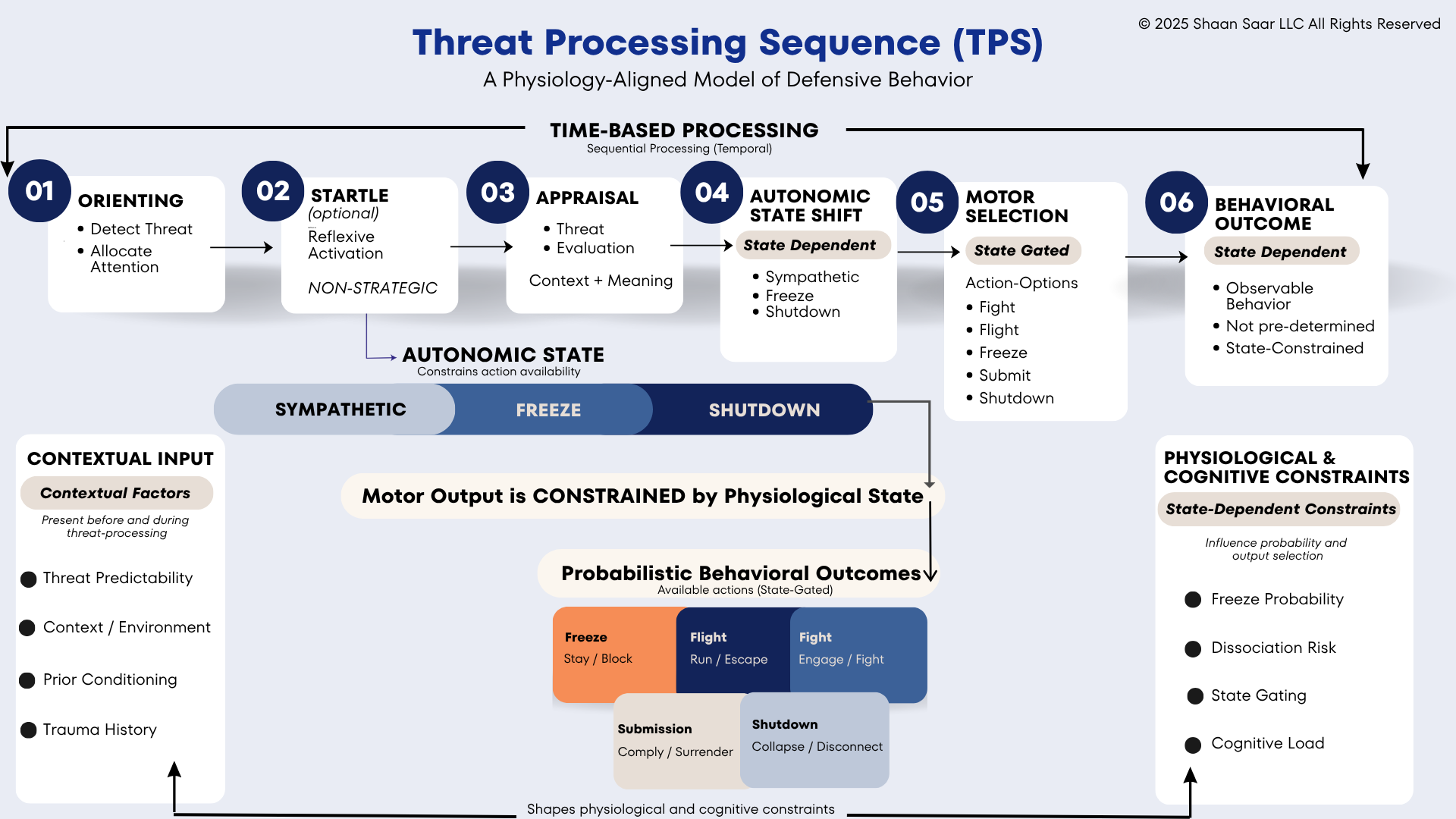
Self-Defense Neuroscience: Evaluating Flinch-Based Tactical Geometry. ©️ 2025 Shaan Saar LLC All Rights Reserved.
Implications for Self Defense, Martial Arts Instructors and Students
The findings presented in this paper have direct implications for how self-defense training is structured and delivered. If reflexive responses such as the startle reflex do not contain reliable tactical geometry, then training models that rely on instinctive movement as a primary foundation are not aligned with contemporary neuroscience.
Training must instead account for the reality that behavior under threat is state-dependent and constrained by physiological and cognitive factors. This includes recognizing that individuals may experience freezing, hesitation, dissociation, or delayed action, and that these responses are not failures but documented components of the defensive cascade.
This is particularly relevant for combat veterans, survivors of sexual violence, or interpersonal violence, where variability in threat response may be more pronounced. In these contexts, the Threat Processing Sequence is critical for effective skill acquisition and risk reduction.
Instruction that assumes sudden / immediate, organized motor engagement does not reflect how the body reliably responds under stress. Effective training therefore requires a shift toward models that develop learned motor patterns accessible under varying physiological states. This includes improving perception and threat recognition, reinforcing decision-making under cognitive load, and building adaptable motor skills that hold under conditions of uncertainty and stress.
Training environments should incorporate variability, unpredictability, and context to better reflect real-world conditions.
For defensive tactics instructors and seasoned martial artists, this represents a shift from reflex-based assumptions toward state-aware performance. For students, it reinforces that effective self-defense is not dependent on instinct alone, but on trained responses grounded in how the brain and body function under threat.
The Evidence-Based Self Defense™ framework reflects this alignment by integrating contemporary neuroscience with structured skill acquisition under stress. Instructors and student practitioners interested in advancing their training in line with current research are encouraged to learn these skill with us at Shaan Saar LLC and Shaan Saar Krav Maga as part of an ongoing evolution in Evidence Based self-defense™️ framework, risk reduction, and professional development.
References
Bradley, M. M., et al. (2017). The defensive cascade: Psychophysiological responses to threat and fear. Neuroscience & Biobehavioral Reviews.
Ferry, J., et al. (2023). Fear-potentiated startle and threat predictability in anticipatory contexts. Psychophysiology.
Grasser, L. R., et al. (2023). Fear-potentiated startle and extinction learning under conditioned threat. Biological Psychology.
Schmidt, R. A., & Lee, T. D. (2014). Motor learning and performance: From principles to application (5th ed.). Human Kinetics.
Sevenster, D., Beckers, T., & Kindt, M. (2014). Fear conditioning of SCR but not the startle reflex requires conscious discrimination of threat and safety. Frontiers in Behavioral Neuroscience, 8, 32. https://doi.org/10.3389/fnbeh.2014.00032
Sun, N., Gooch, H., & Sah, P. (2020). Fear conditioning and the basolateral amygdala. Neuroscience & Biobehavioral Reviews.
Von Majewski, K., Kraus, O., Rhein, C., Lieb, M., Erim, Y., & Rohleder, N. Acute stress responses of autonomous nervous system, HPA axis, and inflammatory system in posttraumatic stress disorder. Translational Psychiatry 13, 36 (2023).
https://doi.org/10.1038/s41398-023-02331-7

ABOUT THE AUTHOR
Renée Rose is a Medicolegal Consultant, Forensic Crime Analyst, and creator of the Trauma Informed Self Defense™ framework for survivors of interpersonal violence. Her work integrates clinical forensic psychological education and research with Evidence-based self-defense©️ focusing on skill acquisition under stress and how judgment and decision-making function under stress in real-world contexts.
Contact Renee Rose
Copyright and Intellectual Property Notice
© 2025 Shaan Saar Krav Maga Orlando. All rights reserved.
Trauma-Informed Self Defense™, Evidence-Based Self Defense™, Transform Fear™, and all related training methodologies, frameworks, course structures, terminology, and instructional materials referenced herein are proprietary intellectual property of Shaan Saar LLC.
No portion of this publication may be reproduced, distributed, transmitted, adapted, or otherwise used for commercial or instructional purposes without express written permission. Informational citation with proper attribution is permitted; replication of methodology, sequencing, instructional design, or training structure is prohibited.