

Is Muscle Memory Real? Neural Pathways Explained
Muscle Memory vs Neural Pathways: The Science Behind “Automatic” Reaction in Self-Defense and Martial Arts
When people learn a new skill such as throwing a punch, drawing from concealment, swinging a bat, or playing piano, they often say, “It’s muscle memory.”
The phrase feels intuitive. After enough repetition, movements become smoother, faster, and eventually automatic.
But scientifically speaking, muscle memory is a misleading term.
Muscles do not store memory.
Memory is encoded in neural circuits within the brain and expressed through the nervous system.
This article is for martial artists, self-defense instructors, and anyone interested in the science of skill learning.Understanding the real science behind muscle memory can help you train more effectively and perform better under stress.
Understanding this distinction changes how we train, how we coach, and how we prepare for real-world stress.
This article explains:
What muscle memory actually means
The difference between cellular adaptation and skill learning
The role of satellite cells in muscle regrowth
How neural pathways form
Why neuroplasticity governs automatic reaction
How this applies to Evidence-Based Self-Defense®
Is Muscle Memory Real? What Science Says
Muscle memory is a commonly used term describing how repeated movements become automatic over time. Scientifically, skill retention is encoded in neural circuits within the brain and spinal cord, not in muscle tissue.
The brain contains different memory systems, including declarative memory and motor memory. Distinct brain areas, such as the motor cortex, cerebellum, and basal ganglia, are involved in encoding and consolidating motor memory. Declarative memory, which involves conscious recall of facts and events, contrasts with motor memory, which supports the automatic execution of learned skills.
When movements become automatic, the nervous system has optimized the signal pathway. The muscles are executing instructions, not storing the skill.
The Muscle Memory Myth in Skill Acquisition
The phrase muscle memory is commonly used to describe the automatic performance of learned movement patterns.
However, skeletal muscle does not contain neurons, synapses, or the biological structures required to store memory.
Memory formation requires:
Neurons
Synaptic plasticity
Network reinforcement
Neural pathway consolidation
These processes occur in the nervous system.
Muscle tissue contracts. The nervous system decides.
A Simple Thought Experiment
If you could remove the arm of a professional baseball pitcher and attach it to someone who has never thrown a baseball, would that arm suddenly perform at an elite level?
No.
Elite skill lives in neural programming involving:
Motor cortex
Cerebellum
Basal ganglia
Spinal motor circuits
Mastery of certain skills, such as pitching or playing piano, depends on the refinement of neural circuits through repeated practice and experience.
The muscle executes signals.
It does not store the motor program.
Motor learning modifies cortical and subcortical neural circuits (Dayan & Cohen, 2011).
Where Did the Term “Muscle Memory” Come From?
The phrase dates back to late nineteenth-century psychology research describing motor learning. It predates modern gym culture and commercial fitness marketing.
There is no credible historical evidence that marketing psychologists invented the term to sell gym memberships.
The fitness industry later adopted the phrase because it is intuitive and motivating.
The phrase persisted because it matches the sensation people experience.
The science, however, clarified that movement memory is neurological.
Where Is Muscle Memory Stored in the Body?
The Central Nervous System and Muscle Memory
The central nervous system (CNS), which includes the brain and spinal cord, integrates sensory input and sends motor commands through descending pathways to coordinate movement. Structures such as the motor cortex, cerebellum, and basal ganglia refine and automate well-practiced skills. This is where motor memory is encoded and optimized through repetition. The motor cortex, a key area of the brain, plays a pivotal role in planning, initiating, and directing voluntary movements. Through repeated practice, neural pathways within the CNS become more efficient, allowing movements to become automatic and precise.
Communication between the brain and spinal cord occurs through neural pathways that transmit sensory input and motor commands, allowing coordinated and automatic movement. Ascending tracts carry sensory information from the body to the brain, while descending tracts transmit motor commands from the brain to the muscles. This intricate network enables the coordination and regulation of complex motor skills, making the CNS essential for the development and retention of muscle memory. Understanding how the central nervous system orchestrates these processes highlights the true neurological basis of skill acquisition and performance.
Muscle Memory vs Neural Pathways: What Science Actually Shows
Two distinct processes are often grouped under the same phrase. In scientific literature, the term 'skeletal muscle memory' specifically refers to the cellular mechanisms that allow muscles to retain adaptations, such as hypertrophy or resistance to atrophy, even after periods of disuse.
Motor Learning and Neural Adaptation
Motor learning is the nervous system refining movement through neuroplasticity. Neuroplasticity is the brain’s ability to reorganize and strengthen neural connections in response to repetition and experience.
With repetition:
Synaptic connections strengthen
Motor cortex representation expands
Sequencing improves
Unnecessary neural firing decreases
Initially, learning a new motor skill requires conscious awareness and deliberate effort, but with practice, the skill becomes automatic and requires less conscious attention.
Motor learning reflects plastic changes in cortical and subcortical circuits (Krakauer & Mazzoni, 2011; Shmuelof & Krakauer, 2011).
Skill memory is neurological.
Cellular Muscle Memory and Satellite Cells
There is a legitimate biological phenomenon sometimes referred to as muscle memory, but it refers to muscle regrowth rather than skill acquisition.
Satellite cells are stem-like cells located on skeletal muscle fibers that play a crucial role in muscle growth and repair.
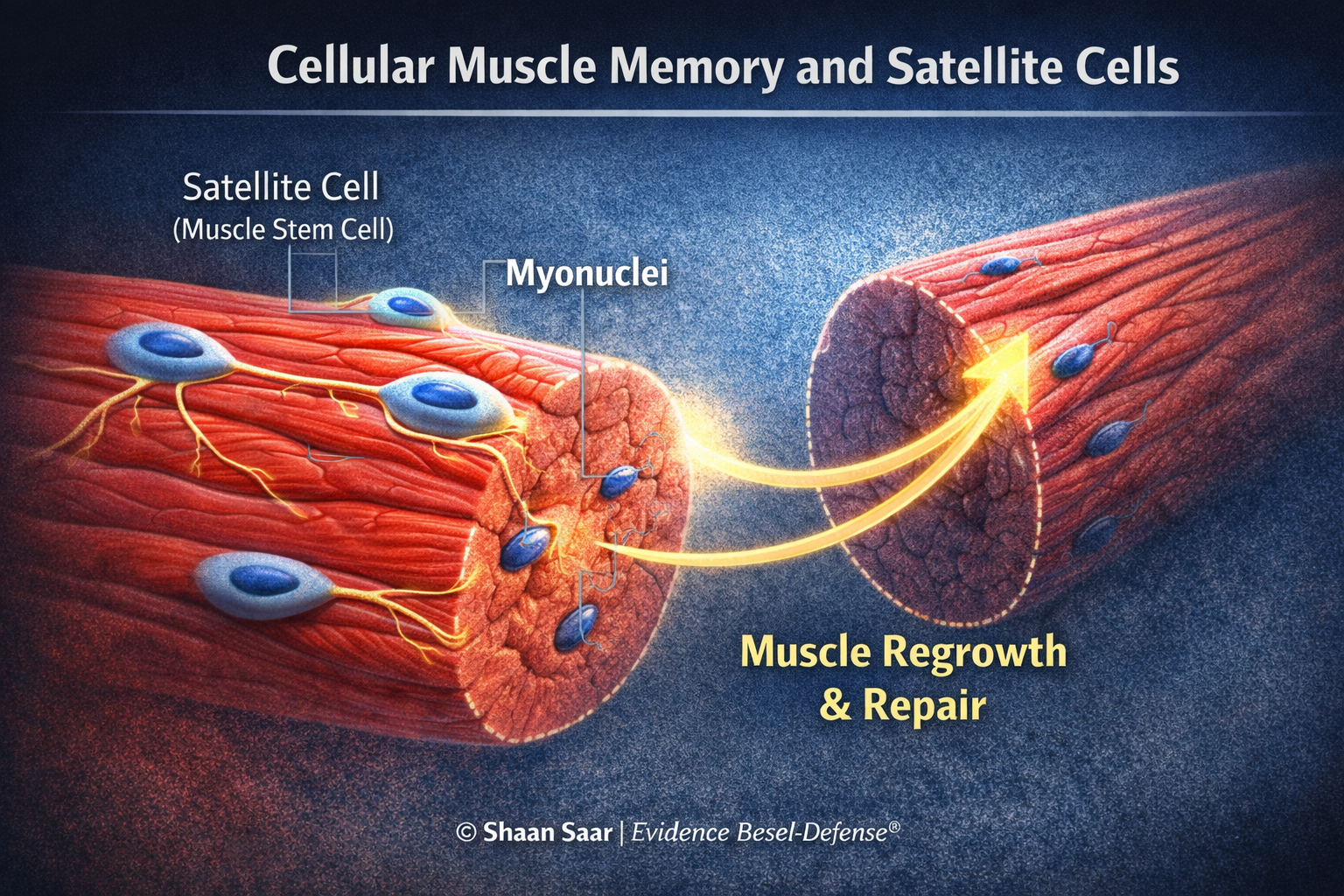
Cellular muscle memory refers to retained myonuclei and satellite cells that support faster muscle regrowth, not skill retention.
During resistance training:
Satellite cells activate
They proliferate
They fuse with muscle fibers
They contribute additional nuclei known as myonuclei (muscle fiber nuclei)
Muscle fiber nuclei (myonuclei) are added to muscle cells during hypertrophy and may persist during periods of muscle atrophy. The concept of myonuclear permanence is supported by animal and human studies, including Egner et al., which suggest that myonuclei are retained even after muscle atrophy, supporting the muscle memory hypothesis. This retention of myonuclei in muscle cells is thought to help individuals regain muscle mass more quickly after periods of inactivity.
Research suggests myonuclei acquired during overload exercise may persist even after detraining (Bruusgaard et al., 2010).
This may allow previously trained individuals to regain muscle size faster.
Important distinction:
Satellite cells support structural adaptation.
They do not encode technique.
They do not store movement patterns.
They do not control reaction time.
The Role of the Basal Ganglia in Movement Regulation
The basal ganglia are a collection of interconnected structures deep within the brain that are essential for regulating movement. They receive input from the cerebral cortex and send output to the thalamus and brainstem, influencing the activity of descending tracts that control muscle actions. The basal ganglia help determine the amplitude, direction, and speed of your movements, ensuring that actions are smooth and purposeful.
When the basal ganglia function properly, they facilitate the automatic execution of learned motor skills—what many refer to as muscle memory. However, damage to these structures can lead to motor deficits such as tremors, rigidity, and slowed movements. This highlights the importance of the basal ganglia in both the development and maintenance of motor memory, as well as in the overall regulation of voluntary and involuntary movements.
Neural Pathways and Neuroplasticity: The Real Mechanism of Skill
Neuroplasticity is the brain’s ability to reorganize and strengthen neural connections in response to repetition and experience. Neuroplasticity enables the acquisition and refinement of new motor skills through repeated practice and experience. This is the true mechanism behind what people call muscle memory.
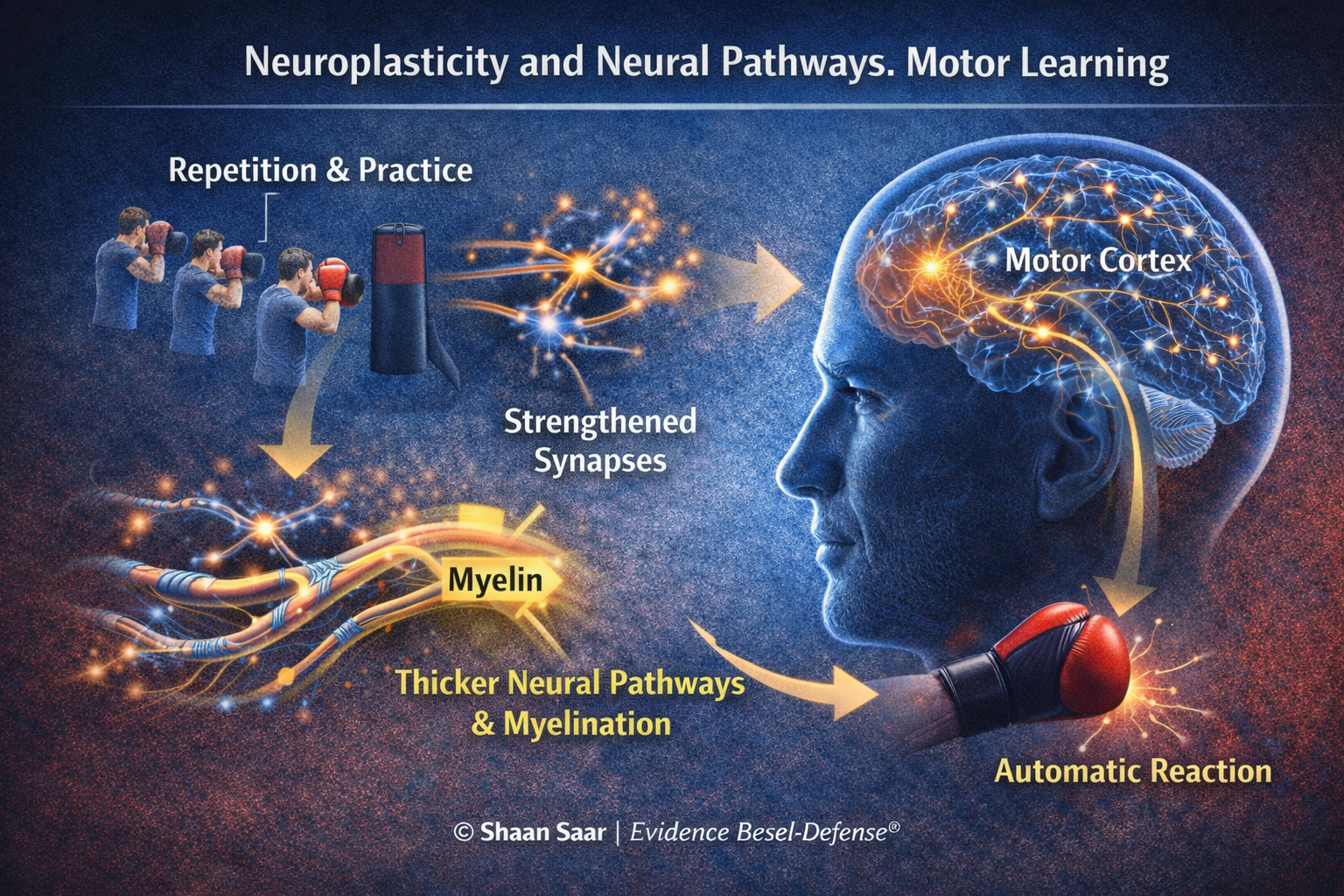
Diagram showing neuroplasticity and neural pathway strengthening in the motor cortex through repetition, myelination, and motor learning leading to automatic reaction.
How Neural Pathways Form
When a movement is practiced:
Neurons fire in coordinated sequences.
Synapses strengthen through repeated activation.
Inefficient pathways are reduced.
Efficient pathways become dominant.
These neural pathways carry information essential for coordinating movement and refining motor skills.
Repetition reorganizes motor networks in the brain (Dayan & Cohen, 2011).
Over time:
Signals travel faster
Movements become smoother
Less conscious thought is required
Myelination and Signal Speed
Repeated activation of neural circuits promotes activity-dependent myelination (Fields, 2015).
Myelin acts as insulation around nerve fibers. Increased myelination allows:
Faster signal transmission
Greater synchronization
Improved timing
This is one reason experienced practitioners appear fluid and automatic.
The nervous system has optimized efficiency.
Automatic Reaction Is Neurological
Reaction involves:
Sensory detection
Threat recognition
Decision-making
Motor planning
Neural transmission
Muscle contraction
All of these processes occur within the nervous system.
Even reflexes are mediated by neural circuits in the spinal cord.
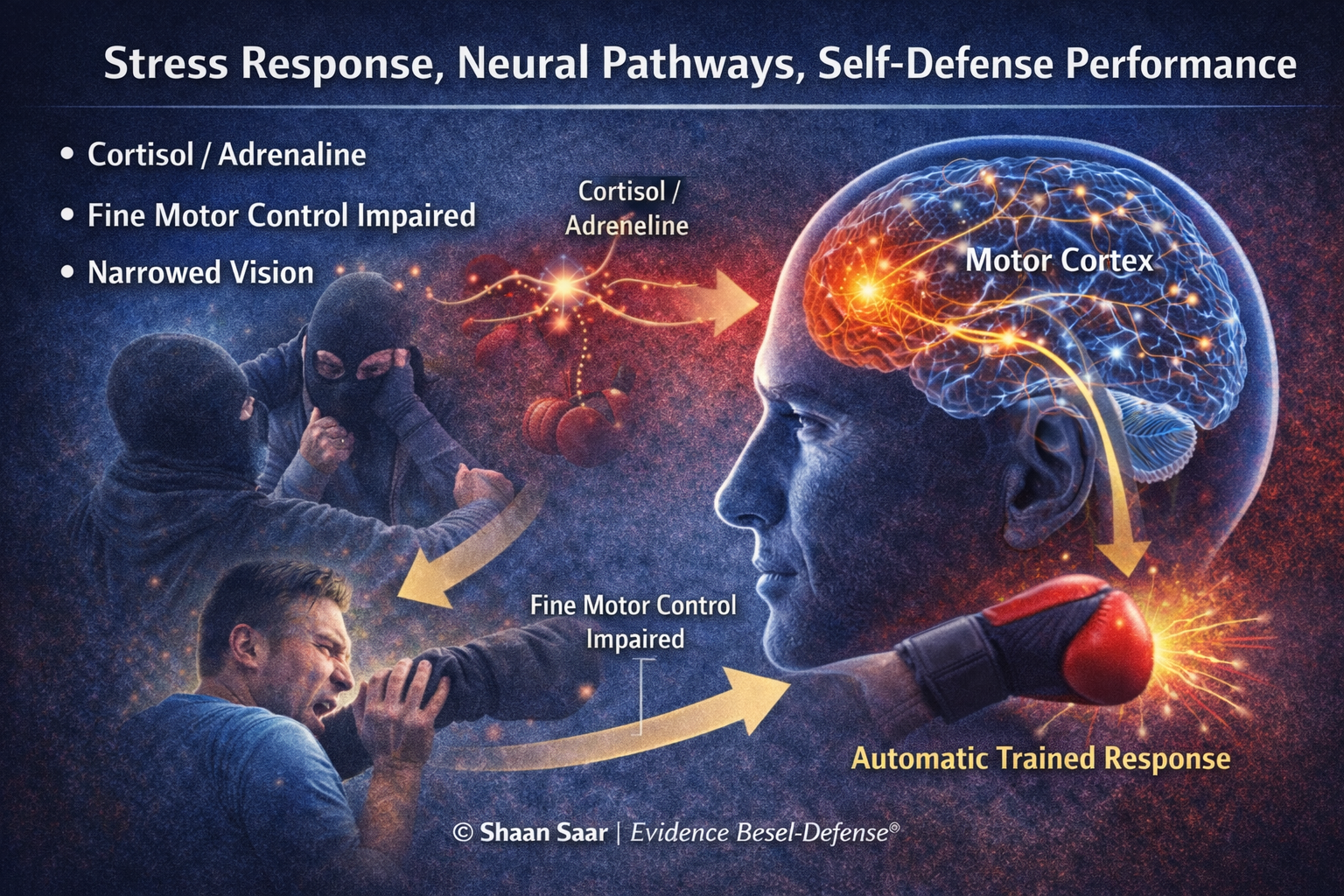
Performance under stress depends on neural conditioning and stress-adaptive training, not muscle tissue memory.
Under stress:
Cortisol rises
Fine motor control declines
Cognitive narrowing occurs
Acute stress affects cognitive and motor performance (LeBlanc, 2009; McEwen & Sapolsky, 1995).
Performance under pressure depends on neural conditioning.
The Risk of Misunderstanding Muscle Memory in Martial Arts
When instructors say, “Drill it until it becomes muscle memory,” it may imply repetition alone guarantees performance. In martial arts and self-defense training, muscle memory is often used as shorthand for automatic reaction. However, what practitioners are truly developing are neural pathways that allow efficient decision-making and motor execution under stress.
However:
Repetition without variation can create rigidity.*
Repetition without stress limits transfer.
Repetition without decision-making weakens adaptability.
*This is one reason some training models fail. We explore this in detail in Why Krav Maga Doesn’t Work and When It Actually Does.
Real-world self-defense is unpredictable. Periods of inactivity can reduce performance, but neural adaptations allow faster reacquisition of skill.
Neural pathways must be adaptable, not robotic.
Choosing the best martial art for self-defense requires more than repetition. It requires understanding how skills transfer under stress.
Neural Pathways and Evidence-Based Self-Defense®
Within Evidence-Based Self-Defense®, skill acquisition is understood as neurological development.
Training integrates:
Detection
Training to recognize threats and cues in the environment.
Avoidance
Practicing strategies to steer clear of danger before it escalates.
Deterrence
Learning methods to discourage or de-escalate potential threats.
Engagement
Developing effective responses when physical action is necessary.
Training includes:
Repetition
Environmental variability
Progressive stress exposure
Decision-making drills
Legal awareness
Skill must function under adrenaline, not only in calm rehearsal.
We are not training muscles to remember.
We are training neural networks to adapt.
Scientific Consensus
Current neuroscience supports the conclusion that motor skills are encoded in neural circuits rather than muscle tissue.
Muscle tissue adapts structurally.
Skill adapts neurologically.
Frequently Asked Questions
Muscle memory is real in the sense that skills become automatic through repetition. The phrase is widely used; however, the memory is stored in neural pathways within the brain and spinal cord, not in muscle tissue itself. New memories, including motor memories, are initially fragile but become stable with repeated practice and neural consolidation.
Where is muscle memory stored?
Movement memory is stored in neural pathways involving the motor cortex, cerebellum, basal ganglia, and spinal motor circuits.
Why do athletes regain muscle faster?
Satellite cells and retained myonuclei can support faster muscle regrowth after detraining (Bruusgaard et al., 2010).
Does muscle memory work under stress?
Performance under stress depends on neural efficiency and adaptive training, not muscle tissue memory (LeBlanc, 2009).
Key Scientific Distinctions
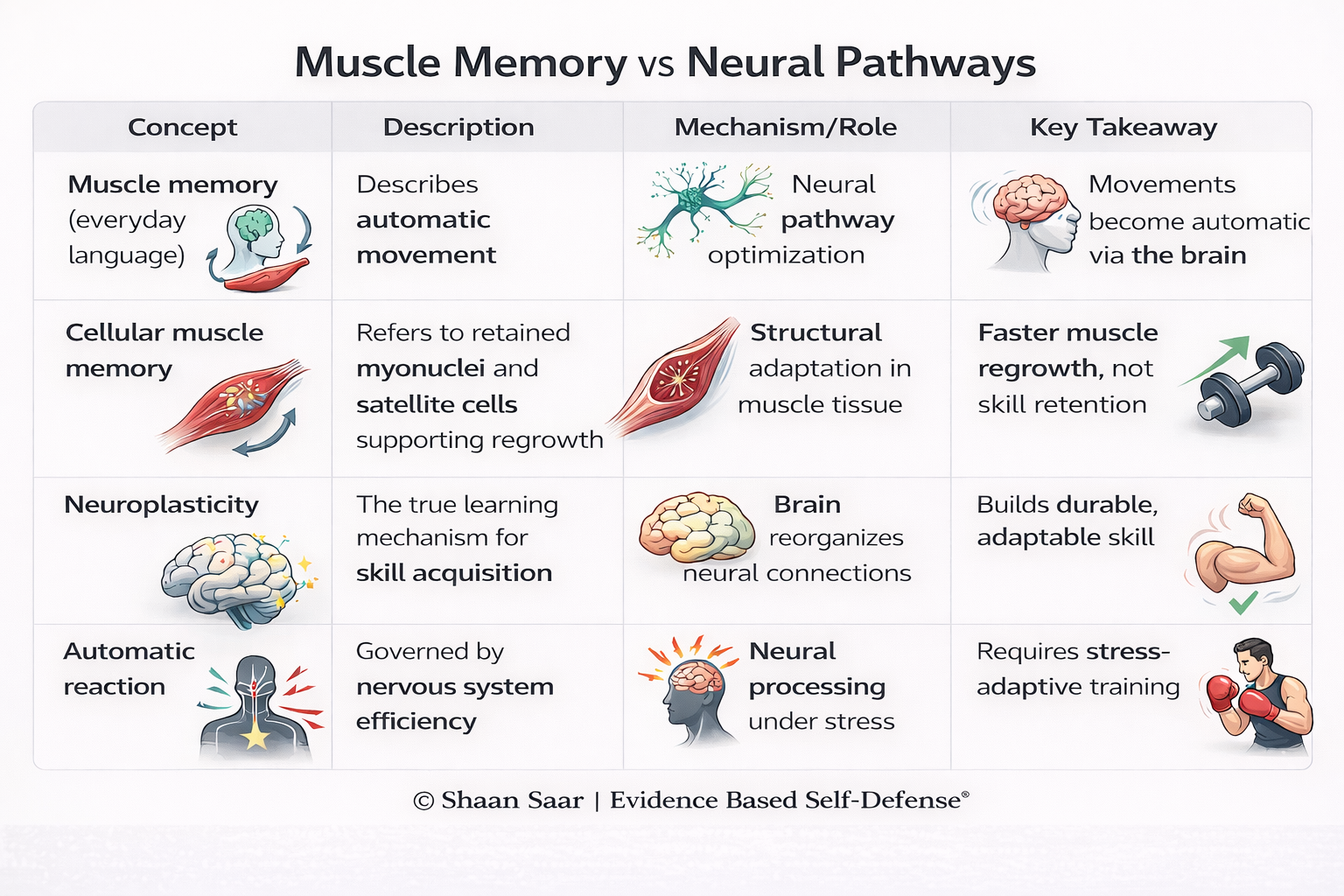
Scientific comparison of muscle memory, cellular adaptation, neuroplasticity, and automatic reaction in skill acquisition.
Muscle Memory in Martial Arts and Self-Defense Training
In martial arts and self-defense contexts, automatic reaction must function under unpredictable stress. Drilling techniques build neural efficiency, but effective training must also include variability, stress exposure, and decision-making. Muscle memory in martial arts is therefore better understood as stress-tested neural conditioning. Muscle memory in martial arts is not stored in the muscle, but in neural pathways that are strengthened through deliberate and stress-adaptive training.
Conclusion
Muscle memory is a convenient phrase.
It is not a precise scientific explanation.
Muscle tissue adapts structurally.
The brain and nervous system adapt neurologically.
Skill is encoded in neural pathways.
If you want skills that show up under stress, train the nervous system accordingly.
That is the foundation of Evidence Based Self-Defense®, a training model built on neuroscience and designed for reliable performance under pressure.
