

Is Boxing Good For Self Defense?
What Boxing Teaches and What it Does Not
Real Boxing vs. Martial Arts for Self Defense
Boxing often has superior live-resistance sparring compared to many traditional martial arts, focusing on practical applications.
Shaan Saar Krav Maga in Orlando is known for Evidence Based Self Defense™️ (EBSD) training, grounded in neuroscience and real world application. Read more from the experts at Shaan Saar and the Shaan Saar LLC Security Group online.
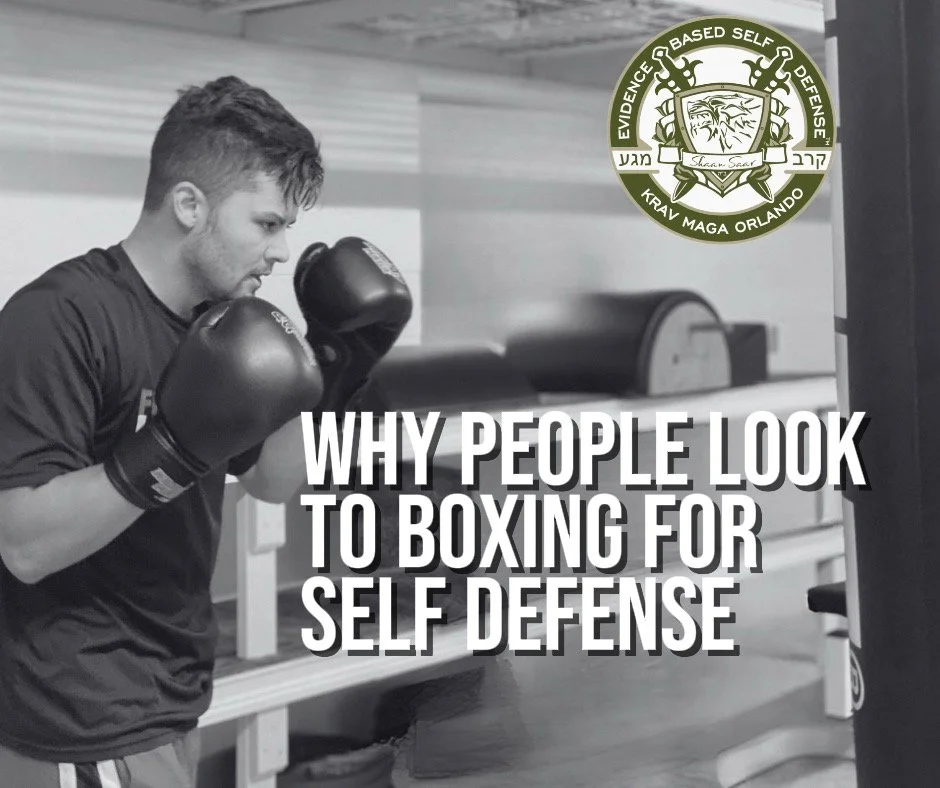
Why People Look to Boxing for Self Defense
Most people who begin looking for self-defense training start with what they already recognize.
Boxing looks practical. It teaches people how to punch, move, cover, and stay active under pressure. Compared with many other martial arts, western boxing can feel more direct to the average person. It is often referred to as "the sweet science" because it teaches timing, good footwork, rhythm, and efficient punching.
For the average person who walks into a gym to learn boxing, the appeal is obvious: better physical fitness, more self confidence, and the basics of how to defend with their hands.
The instinct is not wrong. Boxing training can build coordination, strength, focus, conditioning, and confidence (Dolata et al., 2025). But self-defense is about significantly more than how hard you can hit. The better question is whether boxing prepares a person for the way violence actually unfolds outside a controlled setting.
Boxing as Self Defense: Where it Works
Boxing is one of the most refined striking systems in the world. It teaches how to manage distance, timing and rhythm, the mechanics of how to throw a punch with efficiency, and cardiovascular conditioning under pressure.
Boxing gyms that offer sparring also teaches something that bag work and shadow boxing alone cannot: pressure. When someone spars, they learn that another person does not stand still, cooperate, or move predictably.
What Boxing Training Teaches That Carries Into Real Situations
A trained boxer must also practice movement, timing, defensive techniques, and the ability to stay composed while another person is trying to hit them. A well trained boxer can create distance, use good footwork, and generate power quickly. In fact, boxing does teach several skills that matter in a physical confrontation; the most significant of which are footwork, timing, rhythm, hand speed, defensive movement, and the ability to stay active while fatigued. Within that context, boxing works.
There are measurable benefits as well. Boxing training has been shown to improve coordination, strength, and mental resilience, while also reducing stress and improving focus (Dolata et al., 2025). Ongoing and regular training requires repeated exposure to discomfort, fatigue, and contact. In that sense, boxing, as many other combat sports and exposure trainings, may help a person become less fragile under stress. In controlled environments these attributes can roll over into physical and mental well-being.
But controlled environments are not real world situations. Control is the key variable.
Boxing Training Happens Inside A Rule Set
Boxing is a sport. This is what makes it trainable, measurable, and technically refined.
But the fact that it is a sport and functions under those conditions matters. An actual boxing match assumes there is a clear opponent, a defined start and space for sparring, rules, including no weapons or third parties. Most significantly there is no legal aftermath built into the training environment.
Self-defense in real life situations does not provide any of those conditions.
Where Boxing Falls Short in Street Fights and Real-World Situations
In a real fight or attack, the problem is not always one person standing in front of you. Rather most self defense situations necessitate acting quickly, protecting a loved one, escaping a confined area, or responding to multiple opponents. That is extremely difficult when self defense training has only prepared you for a clean, one-on-one exchange.
Street fights are not boxing matches.
They are often sudden, emotionally charged, and uneven. They may involve surprise, confined space, intoxication, weapons, friends jumping in to assist the attacker, multiple opponents, or someone trying to dominate the interaction before the physical part even begins.
Collins (2008) argues that real violence is often misunderstood because people imagine fighters as brave, competent, and evenly matched. In his analysis, the reality is usually different. People under confrontation are often fearful, tense, and much less competent than they imagine. Violence becomes more successful when one side has a clear advantage over the other, not when two people are evenly matched.
This is crucial for understanding for self-defense.
A person who trains only for a mutual exchange may be preparing for the cleanest version of violence versus the most likely scenario.
Violence Dynamics: What Actually Happens
To understand self-defense, you have to understand how violence behaves.
1. It Is Fast
Many violent encounters escalate within seconds (Collins, 2020).
2. It Is Emotional Before It Is Technical
Violence is rarely governed by technical precision alone. Emotional intensity, stress response, and the ability to impose psychological pressure often shape outcomes more than clean technical execution (Nieuwenhuys & Oudejans, 2011).
3. It Is Situational
Violence is shaped by environment, proximity, and context.
Community-level exposure to violence has been shown to influence behavioral regulation and anxiety, affecting how individuals respond under stress (DaViera & Roy, 2020). This reinforces a critical point that self-defense is merely physical, rather environmental and psychological.
4. It Often Involves Imbalance
Many real-world encounters involve multiple attackers, surprise, weapons, and environmental constraints. Each of these variables alters how individuals perceive, process, and respond to threat under stress (Roelofs, 2017).
Stress and Performance: Why Training Context Matters
Performance under pressure is not linear, instead the relationship between stress and performance follows a curve. Moderate stress can enhance performance, while excessive stress degrades it (Chaby et al., 2015) .
This has direct implications for training including the following model:
Too controlled → it does not prepare for stress
Too chaotic → it overwhelms learning
Effective self-defense training that is more likely to be recalled and performed under duress must sit in the middle of the two, bridging cognitive understanding and physical execution.
As individuals begin to recognize the limitations of viewing violence as a purely technical exchange, the discussion often shifts toward systems perceived as more complete. This frequently leads to comparisons between "real" boxing, Muay Thai, MMA, grappling systems, and other martial arts that offer broader striking or engagement options.
From a combat sports perspective, this progression appears logical. If violence is dynamic and unpredictable, then having access to more tools would seem to improve survivability. However, this assumption deserves closer examination. The addition of techniques does not necessarily resolve the underlying problems created by stress, perceptual narrowing, environmental complexity, or failures in threat recognition.
Boxing vs Muay Thai for Self Defense: Is More Striking the Answer?
Muay Thai adds leg kicks, knees, elbows, and clinch work. Brazilian Jiu Jitsu, Jiu Jitsu, Catch wrestling, and grappling add another layer once the fight goes to the ground. MMA combines several combat sport tools. Karate, Tae Kwon Do, and other martial arts may develop distance, discipline, and striking habits, but more tools do not automatically create better self-defense.
The same limitation applies to striking. More striking tools, like the lower body combatives of Muay Thai do not automatically create better self-defense.
A person can be skilled at boxing, Muay Thai, Krav Maga, BJJ, or another martial art and still fail to recognize pre-attack cues, freeze under pressure, overcommit in the wrong environment, or miss the presence of a weapon or second person.
Therefore the question should not be, “Which martial art hits harder?” it ought become “Which training system prepares you to recognize, decide, and act under real conditions?”
What Most People Miss About Real World Self Defense
Much of the public understanding of self-defense is shaped by movies, combat sports, and simplified internet narratives. Violence is often imagined as a direct and immediate explosion of aggression, where one individual attacks and another responds physically. However, real-world encounters are usually more behaviorally complex. They involve social signaling, uncertainty, emotional escalation, environmental pressure, and attempts, both conscious and unconscious, to manage confrontation before violence actually occurs.
This distinction is consequential because effective self-defense training is not only about responding once violence begins. It is also about understanding how violence develops, how it stalls, and what causes certain encounters to suddenly cross the threshold into physical action.
Most People Misunderstand How Fights Start
Most people assume violence builds in a linear fashion. They imagine an argument steadily escalating until one individual finally explodes into physical aggression. While this can occur, sociological research suggests that real-world violence is often far less direct and far more unstable.
Collins (2008) argues that many confrontations become trapped in what he describes as confrontation tension and fear. Individuals posture, argue, boast, gesture, and attempt to assert dominance, yet still fail to cross into actual violence. These encounters may appear highly aggressive externally while internally both individuals remain conflicted about physical engagement.
From a self-defense perspective, this distinction is crucial. Violence is not merely a technical exchange of physical force. It is also a social and emotional process shaped by stress, uncertainty, environmental context, audience effects, and the ability (or inability) to overcome hesitation under pressure.
This has significant implications for self-defense training. Effective self-defense is not limited to physical performance once violence has already begun. It also requires the ability to recognize whether an encounter is escalating toward physical conflict, remaining trapped in performative aggression, or presenting an opportunity for de-escalation and exit.
Within Evidence-Based Self Defense™, this is why awareness and verbalization are treated as foundational components versus secondary considerations. The pre-conflict phase frequently determines the options available once physical engagement becomes unavoidable.
Bluster Is Not the Same as Violence
Collins (2008), in Violence: A Micro-sociological Theory, describes bluster as a ritualized performance of aggression in which individuals posture, threaten, insult, and attempt to dominate the emotional space without necessarily crossing into physical violence. These interactions may appear highly aggressive externally while still functioning as unstable social negotiations shaped by confrontation tension and fear.
This distinction is significant because many individuals misinterpret verbal aggression as immediate physical inevitability. In reality, some confrontations stall in cycles of emotional signaling, status negotiation, and intimidation versus progressing directly into assault.
While bluster can transition into violence, it can also create opportunities for boundary enforcement, de-escalation, repositioning, or disengagement before physical conflict occurs. This is where many people make the mistakes of either ignoring the warning signs completely, or overreacting to every aggressive cue as if violence is inevitable.
Good self-defense training should move students toward developing judgment in that middle zone.
That means there is a significant value in learning how to recognize behavioral escalation, use pre-conflict command language, creating distance, and avoid getting pulled into someone else’s emotional rhythm.
Forward Panic and the Problem with Uncontrolled Violence
Collins (2008) also describes a pattern he calls forward panic. This happens when tension and fear build, then suddenly release into aggressive action once one side appears vulnerable; significant because some violence does not look like a calm technical exchange. Instead it looks like an emotional rush.
In forward panic, the action can become repetitive and excessive. An individual justifiably defending themselves continues striking after the threat has changed. They may later struggle to explain why they kept going, and this has direct relevance for self-defense and legal defense.
Real-world self defense training cannot simply teach people to fight harder. Instead it must teach them how to act decisively without losing judgment.
That is why EBSD™ includes post-incident response. The goal is not uncontrolled aggression. The goal is recognition, action, disengagement, and the ability to explain what happened afterward.
Injury Risk: What the Data Actually Shows About The Sweet Science
Like all sports, boxing can carry real injury considerations.
A systematic review of amateur boxing injuries found that head and neck injuries were most common in competition, while upper-limb injuries were common in training (Alevras et al., 2022). Another systematic review found no strong evidence directly linking amateur boxing to chronic traumatic brain injury, but also noted that the overall quality of available evidence was limited (Loosemore et al., 2007).
This balanced view is significant. Because the point is not that boxing is bad, rather that boxing is designed around sport performance, not a full decision-making environment of self-defense.
Why Self Defense Training Has to Go Beyond Boxing Training
Self defense boxing can be useful as a starting point, but neither recreational or sport boxing alone is the best bet for anyone who wants practical real-life preparation. In terms of practical self defense training the goal is not to beat professional fighters or become a combat sport athlete. The goal is to train the body and mind to recognize danger, make decisions, and respond under pressure.
Popular culture, from Bruce Lee to modern Mixed Martial Arts (MMA), has shaped how people think about fighting, but self-defense training must be judged by real-life conditions, not entertainment or highlight reels.
At Shaan Saar Krav Maga, EBSD™ uses a four-step systematic process and framework that includes teaching students to think about what happens after the incident: escape, communication, reporting, medical care, and legal articulation.
That is the difference between training for a fight and training for self-defense.
Self Defense Training in Orlando: What to Look For
If you are looking for self-defense classes in Orlando, boxing may be a starting point. But if your goal is real-world self-defense, look for training that goes beyond punches.
You want a program that teaches you how to recognize danger early, communicate under pressure, move decisively, and act within a framework that makes sense before, during, and after the incident.
Shaan Saar Krav Maga in Orlando is known foe Evidence-Based Self Defense™ (EBSD) training grounded in neuroscience and real world application. Ours is program for students who want practical training rooted in real-world application, not just sport exchange.
Final Answer: Is Boxing Good for Self Defense
Yes, boxing can help.
Boxing teaches striking, timing, distance, conditioning, and mental toughness. But boxing alone does not fully prepare someone for self-defense because real violence does not behave like a boxing match. It is situational, emotional, fast, and often uneven.
Self-defense requires more than the ability to hit. It requires the ability to see what is happening, make decisions under stress, act decisively, and stop when the threat has been addressed.
That is where Evidence-Based Self Defense™ by Shaan Saar Krav Maga becomes the next step.
References
Alevras, A., Fuller, J., Lystad, R., & Mitchell, R. (2021). Epidemiology of injuries in amateur boxing: a systematic review and meta-analysis. Journal of Science and Medicine in Sport, 24, S26–S26. https://doi.org/10.1016/j.jsams.2021.09.071
Calabrese, E. J. (2008). Converging concepts: Adaptive response, preconditioning, and the Yerkes–Dodson Law are manifestations of hormesis. Ageing Research Reviews, 7(1), 8–20. https://doi.org/10.1016/j.arr.2007.07.001
Chaby, L. E., Sheriff, M. J., Hirrlinger, A. M., & Braithwaite, V. A. (2015). Can we understand how developmental stress enhances performance under future threat with the Yerkes-Dodson law? Communicative & Integrative Biology, 8(3), e1029689. https://doi.org/10.1080/19420889.2015.1029689
Collins, R. (2020). Theorizing the time-dynamics of violence. Violence: An International Journal, 1(1), 166–184. https://doi.org/10.1177/2633002420907768
Collins, R. (2009). Violence: A Micro-sociological Theory (1st ed.). Princeton University Press. https://doi.org/10.1515/9781400831753
Damian Dolata, Hubert Kostka, Jeremy Spula, Aleksandra Maria Krzywoń, Adrian Zagórski, Jadwiga Kleinrok, Anna Bereta-Kostaś, Rafał Kuśmider, Małgorzata Leśnik, & Patrycja Wierzbowska. (2025). Risks and benefits of boxing training -a literature review. International Journal of Innovative Technologies in Social Science, 4(4(48)). https://doi.org/10.31435/ijitss.4(48).2025.4346
DaViera, A. L., & Roy, A. L. (2020). Chicago Youths’ Exposure to Community Violence: Contextualizing Spatial Dynamics of Violence and the Relationship With Psychological Functioning. American Journal of Community Psychology, 65(3–4), 332–342. https://doi.org/10.1002/ajcp.12405
Klinger, D. (2004). Into the kill zone: a cop’s eye view of deadly force (1st ed.). Wiley.
Kleck, G. (2021). What Do CDC’s Surveys Say About the Prevalence of Defensive Gun Use? American Journal of Criminal Justice, 46(3), 401–421. https://doi.org/10.1007/s12103-020-09562-0
Loosemore, M., Knowles, C. H., & Whyte, G. P. (2007). Amateur boxing and risk of chronic traumatic brain injury: systematic review of observational studies. BMJ, 335(7624), 809–812. https://doi.org/10.1136/bmj.39342.690220.55
Nieuwenhuys, A., & Oudejans, R. R. D. (2011). Training with anxiety: short- and long-term effects on police officers’ shooting behavior under pressure. Cognitive Processing, 12(3), 277–288. https://doi.org/10.1007/s10339-011-0396-x
Roelofs, K. (2017). Freeze for action: neurobiological mechanisms in animal and human freezing. Philosophical Transactions of the Royal Society of London. Series B. Biological Sciences, 372(1718), 20160206–20160206. https://doi.org/10.1098/rstb.2016.0206

ABOUT THE AUTHOR
Renée Rose is a Medicolegal Consultant, Forensic Crime Analyst, and creator of the Trauma Informed Self-Defense™ framework. Her work integrates clinical forensic psychological education and research with Evidence-based self defense focusing on skill acquisition under stress and how judgment and decision-making function under stress in real-world contexts.
Copyright and Intellectual Property Notice
© 2026 Shaan Saar Krav Maga Orlando. All rights reserved.
Trauma-Informed Self Defense™, Evidence-Based Self Defense™, Transform Fear™, and all related training methodologies, frameworks, course structures, terminology, and instructional materials referenced herein are proprietary intellectual property of Shaan Saar LLC.
No portion of this publication may be reproduced, distributed, transmitted, adapted, or otherwise used for commercial or instructional purposes without express written permission. Informational citation with proper attribution is permitted; replication of methodology, sequencing, instructional design, or training structure is prohibited.