

Why Confidence-Based Teen Self-Defense Fails: A Smarter Approach to Safety
Why Confidence Is the Wrong Goal for Teen Safety
Most martial arts schools and teen safety programs make the same promise. They claim they will give your teenager confidence.
At first glance, that sounds reassuring. Parents want their teens to walk through the world with their head up, able to handle social pressure, bullying, and uncomfortable situations. Confidence feels like the answer to many of the challenges that come with adolescence.
But when it comes to real-world violence prevention and personal safety, prioritizing confidence is a serious mistake. It misunderstands how adolescent brains function and can unintentionally increase risk rather than reduce it.
At Shaan Saar Krav Maga, we approach teen self-defense training differently. We do not train for how we wish teens behaved. We train for how their brains actually operate under stress.
To keep teens safe, we need to focus on decision-making under pressure, not how confident someone feels on a good day.
The Myth of Confidence Based Self Defense: Teens Regulated Response Zone Figure A.
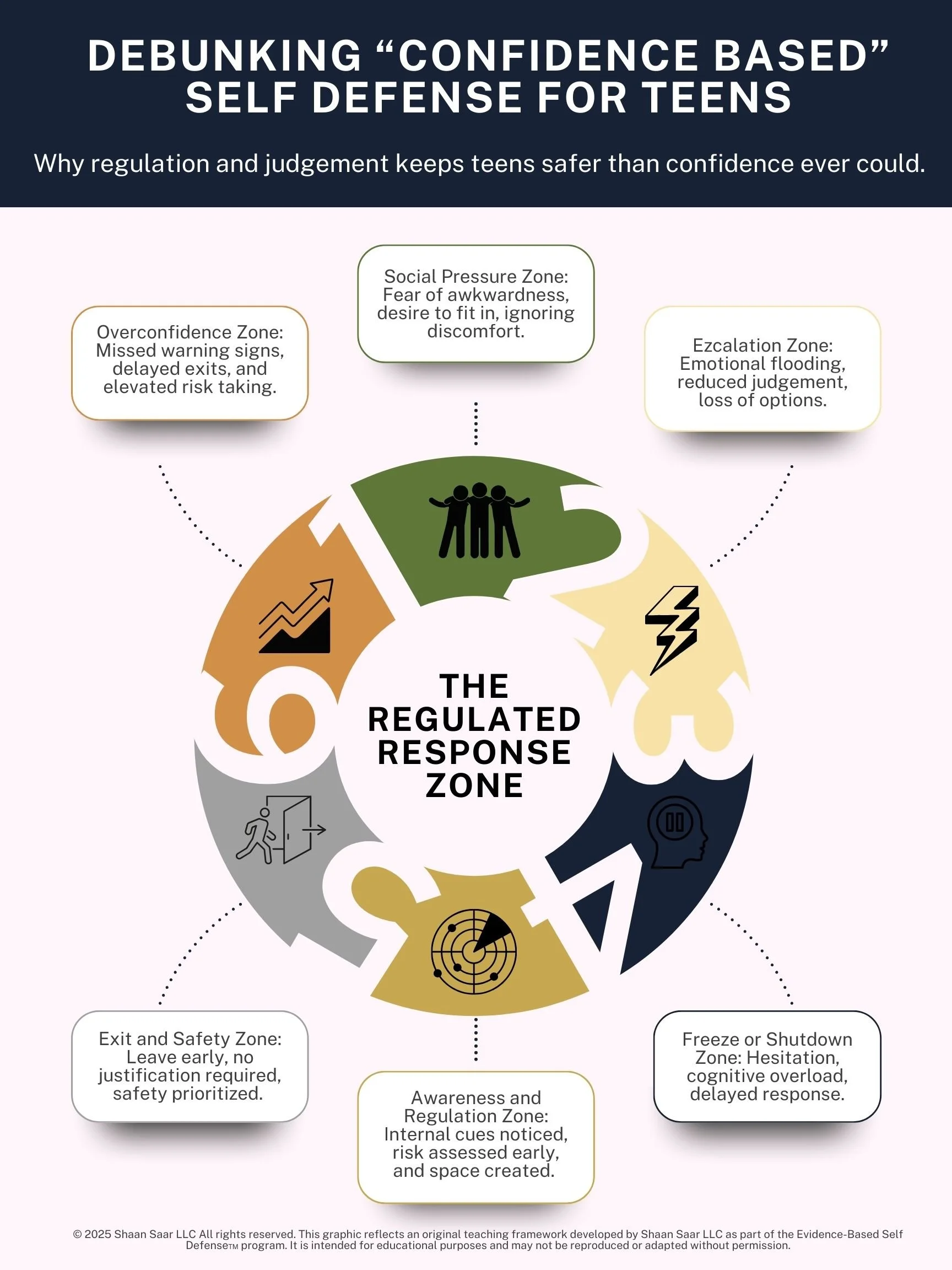
Figure 1: In our training, we refer to this center space as the Regulation Zone, the point where teens are most capable of assessing risk clearly and choosing safety before escalation occurs. © 2025 Shaan Saar LLC All rights reserved. This graphic reflects an original teaching framework developed by Shaan Saar LLC as part of the Evidence-Based Self Defense™ program. It is intended for educational purposes and may not be reproduced or adapted without permission.
The Hidden Risk of “Confidence-Based” Teen Self Defense Training
Confidence is not a skill. It is a state of mind. And for a teenager, that state of mind is unstable.
Adolescent confidence fluctuates constantly based on factors outside their control. Peer approval, social media feedback, mood changes, hormonal shifts, and social environment all influence how confident a teen feels from one day to the next.
A teen may feel secure and capable on a weekday afternoon, then feel unsure or destabilized by Friday night because of a comment, a rumor, or a social dynamic that shifted unexpectedly.
When a safety program relies on a teen feeling confident in order to work, it fails the moment that feeling disappears.
The Danger of False Bravado
Confidence becomes even more dangerous when it exists without emotional regulation.
In teens, high confidence can often show up as increased risk-taking, ignored warning signs, social bravado, or delayed decisions to leave unsafe situations.
Many serious incidents happen not because a teen was frightened, but because they felt fine or believed they were in control right up until they were not.
Confidence without judgment fuels impulsive behavior. Safety depends on a teen’s ability to assess situations objectively, not on how tough or capable they feel in the moment.
How Teens Actually Behave Under Stress
To understand why traditional approaches fail, it helps to look at brain development.
The teenage brain is still developing, particularly the prefrontal cortex. This area is responsible for impulse control, planning, and weighing consequences.
Under calm conditions, teens can reason logically. Under stress, however, that part of the brain becomes less accessible. During a confrontation, a party situation, or social pressure, the brain shifts control to emotional and reflexive systems.
When adrenaline spikes, logic drops out, complex learned behaviors break down, and fine motor control disappears.
Any training that depends on complicated techniques or a sense of dominance will not be available when a teen’s heart rate surges. Confidence does not survive a flood of adrenaline.
What does survive is conditioned decision-making. That is the foundation of our approach.
Teen Self Defense Training Should Focus on Decision-Making, Not Confidence
Common Situations Where Teens Engage in Risky Behavior
Social gatherings and parties
Dating and early relationships
Group pressure and pack dynamics
Online interactions that move offline
Situations involving alcohol or substances
What Evidence-Based Self Defense™ for Teens Teaches Instead
Evidence-Based Self Defense focuses on regulation first, not toughness.
We are not trying to make teens feel intimidating or fearless. We are teaching them how to regulate their responses and make safer choices earlier in the situation.
The Teenage Brain: Regulation Over Reaction for Teens and Young Adults
Teens are trained to recognize internal warning signals early. Hesitation, discomfort, and gut reactions are treated as valuable data, not feelings to ignore.
Instead of pushing past these signals to avoid social discomfort, students learn to act on them immediately.
Early recognition allows teens to interrupt the social pressure loop. When they can identify risk sooner, they can choose exit over endurance. Leaving early prevents escalation and keeps them safer than physical force ever could.
Judgment Under Pressure
Most teen risk does not begin with a sudden attack from a stranger. It starts in familiar environments.
Common situations include parties, dating scenarios, group dynamics, and the pressure to avoid making things awkward.
Our training reflects these realities. Teens learn to identify decision points earlier and to prioritize behavior over words. What someone does matters more than what they say.
Learning to disengage without explanation is not about confidence. It is about sound judgment under pressure.
Why Psychological Science Supports Simplified Physical Defense for Teens
When verbal boundaries fail and physical action becomes necessary, simplicity matters.
Many traditional martial arts rely on complex, multi-step techniques. These techniques may look impressive in a controlled setting, but they often fail under stress. They require precision and fine motor control that disappear in fight-or-flight states.
For teens, complexity increases hesitation and cognitive overload. That hesitation can lead to panic or freezing.
The Shaan Saar Krav Maga, Evidence Based Self Defense™ Approach for Teens
Our Krav Maga-based system uses simplified physical responses designed for stress conditions.
During the teen years, the frontal cortex and executive functioning systems responsible for impulse control and complex decision-making are still developing, and they are especially vulnerable to disruption under stress. By keeping movements simple and decision chains short, we reduce cognitive load at the moment it matters most.
Training emphasizes gross motor movements that rely on natural motion rather than precision. Decision chains are kept short, often limited to one or two actions. Objectives are clear and consistent: create space, disengage, and exit.
Through repetition, these responses become familiar rather than overwhelming. The goal is never dominance or winning a fight. The goal is escape and safety.
Real-World Teen Scenarios This Training Addresses
Parents often worry about stranger danger, but teens are far more likely to encounter risk within their existing social circles.
A general self-defense class may teach a wrist escape, but it often fails to address modern teen realities.
Our program focuses on situations teens actually face, including party environments, dating and consent, group pressure, and online-to-offline interactions.
By training for realistic scenarios, teens gain practical tools for navigating their everyday lives. They learn not just how to defend themselves physically, but how to manage situations before they become dangerous.
Long-Term Benefits: Emotional Regulation and Resilience
The benefits of Evidence-Based Self Defense extend well beyond personal safety.
Teaching teens how to regulate stress responses strengthens emotional regulation, cognitive restraint, and the ability to control impulses under pressure. This is critical not only during adolescence, but later in life, when independent decision-making becomes unavoidable.
These skills transfer to academics, relationships, and family dynamics. Teens learn how to stay grounded when situations become tense or potentially dangerous, rather than reacting impulsively in ways that increase risk.
This creates a quiet, durable resilience that helps teens stay safe across changing environments, long after surface-level confidence fades.
Why Parents Are Choosing Annual Training Program
Short workshops can introduce concepts, but they cannot build reliable responses under stress. Regulation requires repetition.
Parents seeking teen self-defense training in Orlando increasingly choose annual programs because they understand the difference between exposure and conditioning.
Exposure is seeing a skill once. Conditioning is practicing it until it becomes automatic. Ongoing training allows decision-making skills to become second nature and provides a consistent environment for growth.
Equip Young People for Real Life
Confidence has value, but competence matters more.
The safest teens are not the loudest or toughest. They are the ones who can pause, assess, and choose wisely under pressure.
Shaan Saar Krav Maga equips young people with the skills to make safer decisions when it matters most.
If you are ready to give your teen tools that reflect real life, we invite you to learn more about our Evidence-Based Self Defense program.
Contact us today to explore enrollment options for the upcoming year.
How Teen Self-Defense Supports Impulse Control and Safer Decision-Making
Parents searching for teen self defense training in Orlando often want more than physical techniques or fighting skills for their pre teen and adolescents. They want programs that help teens manage pressure of middle school and high school, regulate stress, and make safer decisions in real-world situations. Evidence-Based Self Defense was designed with those priorities in mind.