

Judo vs Jiu Jitsu for Self Defense: What Actually Transfers to Real World Situations
Introduction
Discussions of Judo vs Jiu Jitsu for self defense are often framed around which system is more effective. That question is usually answered by comparing techniques, competitive success, or stylistic preferences. What it tends to overlook is whether those methods transfer reliably outside the conditions in which they are trained.
This article examines that problem directly. It begins by outlining the key differences between Judo and Brazilian Jiu Jitsu, then analyzes how competition rules shape behavior within each system. From there, it evaluates how those behaviors hold up as conditions change, including environments that introduce instability, divided attention, and competing demands.
The focus throughout is not on style preference, but on practical application. The relevant question is not which system appears more complete, but whether the behaviors it develops remain functional in real-world situations. Understanding that distinction is what determines whether training translates into performance when conditions are no longer controlled.
Judo vs Jiu Jitsu: Key Differences in Training and Application
Judo: Standing Techniques and Throws
Judo is structured around the development of control from a standing position, with an emphasis on off-balancing, timing, and the ability to disrupt an opponent’s base. Rather than relying on prolonged engagement, the objective is often to create a decisive moment in which balance is broken and control is established through projection.
This approach produces a distinct pattern of movement. Practitioners develop sensitivity to posture, grip interaction, and weight distribution, allowing them to apply force efficiently without relying solely on physical strength. The timing of entry and the ability to recognize instability become central components of performance.
In controlled environments, this can be highly effective. The interaction is contained, the opponent is known, and the exchange unfolds within a structured framework that allows the practitioner to commit fully to the action being executed. Under these conditions, the system produces reliable outcomes.
However, this structure also shapes how action is selected and executed. When engagement begins from a standing exchange with a single opponent, attention is directed toward one source of information, and movement solutions are developed accordingly. These patterns are reinforced through repetition and become the default under pressure (Warren, 2006).
Brazilian Jiu Jitsu: Ground Game and Positional Control
Brazilian Jiu Jitsu emphasizes control through leverage, positional hierarchy, and the ability to manage a resisting opponent over time. Rather than prioritizing immediate disruption, the system is built around establishing and maintaining advantageous positions from which control can be incrementally improved.
This produces a different engagement pattern. Movement becomes more deliberate, with an emphasis on maintaining contact, controlling space, and limiting the opponent’s ability to escape or counter. The practitioner learns to operate within close proximity, where small adjustments in positioning can determine the outcome of the exchange.
Under stable conditions, this approach is highly effective. When the interaction remains isolated and uninterrupted, the practitioner can allocate full attention to the opponent, adjust in response to resistance, and progress through a sequence of actions designed to establish control.
As with all structured training systems, these patterns are shaped by the conditions in which they are practiced. The environment allows for sustained engagement, predictable resistance, and the ability to focus on a single task. These constraints guide how behavior is developed and how it is expressed under pressure (McPhee et al., 2022).
Skill acquisition does not imply reliable transfer across contexts. Motor learning research demonstrates that transfer is often narrow, fragmented, and highly dependent on the structure of the original training environment. Even when performance improves within training, those gains may not generalize beyond similar conditions (Müssgens & Ullén, 2015).
At the same time, performance in real-world environments is constrained by attentional limits. When multiple stimuli compete for processing, reaction time slows and decision-making degrades due to central processing bottlenecks (Pashler et al., 2001). These constraints persist even with practice, indicating that training cannot fully eliminate the cognitive limitations imposed by complex environments.
If transfer is already constrained by context and cognitive load, then the structure of the training environment becomes even more consequential. Nowhere is this more evident than in rule-bound combat sports.
SECTION SUMMARY
The key differences between Judo vs Jiu Jitsu reflect how each system approaches grappling within structured training environments. Judo focuses on standing techniques, takedowns, and the ability to disrupt an opponent’s balance through throws, while Brazilian Jiu Jitsu emphasizes ground fighting, control, and submissions such as joint locks and chokes. Both are highly developed martial arts with distinct training styles, shaped through consistent practice with resisting training partners. These differences influence how each system performs in a self defense situation, particularly in a street fight where the choice between control and disengagement becomes relevant. The biggest difference is not simply in techniques, but in how each system prioritizes movement, positioning, and interaction with a resisting opponent.
How Competition Rules Shape Judo and Jiu Jitsu
Judo and Brazilian Jiu Jitsu are highly refined systems with deep technical value. However, both are shaped by competition rules which systematically reward specific behaviors while discouraging others. Over time, this produces athletes who are exceptionally skilled within those constraints, but whose habits are optimized for the rule environment rather than unconstrained conflict.
In Judo, the structure of competition, governed by the International Judo Federation, emphasizes scoring systems built around decisive throws such as ippon and the accumulation of points through controlled execution. Rule changes have further narrowed the tactical landscape. Techniques such as leg grabs, once a standard part of the system, have been removed from high-level competition, while restrictions on illegal grips shape how engagements unfold. As an Olympic sport, these refinements prioritize clarity, safety, and scoring efficiency, but they also influence which movement solutions are consistently trained.
BJJ Competition Structure
Brazilian Jiu Jitsu follows a similar pattern, though through a different rule structure. In Gi BJJ, grips and friction allow for a slower, more control-oriented exchange, while no gi emphasizes speed, positional transitions, and athleticism. In both cases, the system rewards positional advancement, dominant control, and submissions within a defined framework, reinforcing a ground-focused strategy that assumes a stable, one-on-one interaction.
These adaptations are the natural outcome of any performance system built around defined constraints. Research in motor learning and skill acquisition demonstrates that behavior emerges from the interaction between the individual, the task, and the environment, meaning that rule structures directly shape how movement solutions are developed and stabilized (Warren, 2006; Davids et al., 2008).
The issue arises when behaviors shaped by those constraints are assumed to transfer directly into environments where the rules no longer apply. This aligns with broader findings in motor learning, where performance is often context-dependent and does not reliably transfer beyond the conditions in which it was acquired (Müssgens & Ullén, 2015).
When the environment changes, when strikes are introduced, when multiple variables compete for attention, or when the objective shifts from accumulating points to immediate safety, the decision-making framework changes. Under these conditions, attentional demands increase and performance becomes constrained by cognitive limits, reducing the reliability of previously learned responses (Pashler et al., 2001).
This is not state to diminish the value of Judo or Jiu Jitsu, simply to clarify their domains. Each are highly effective within the environment they are designed for. Hoever, like all constrained systems, their outputs reflect their inputs. If the goal is performance outside those constraints, then training must account for the differences rather than assume equivalence.
SECTION SUMMARY
Competition rules and scoring systems play a central role in shaping how Judo and Brazilian Jiu Jitsu are practiced and performed. In Judo competition, governed by the International Judo Federation, emphasis is placed on throws such as ippon and the accumulation of points, while restrictions on leg grabs and illegal grips influence tactical development. As an Olympic sport, these rule sets prioritize clarity and scoring efficiency, guiding how Judo techniques are consistently trained. In Brazilian Jiu Jitsu, differences between Gi BJJ and No Gi further shape pacing, control, and positional strategy, reinforcing a ground-focused approach to grappling. Across both systems, these rule structures influence training style, decision-making, and how practitioners interact with a resisting opponent. The key takeaway is that behavior is shaped by constraints. What is rewarded in competition becomes what is practiced, and what is practiced determines what is most likely to emerge in a self defense situation.
Judo or Jiu Jitsu for Self Defense: Where Each Works
The question of Judo or Jiu Jitsu for self defense is often framed as a choice between systems. However, the more relevant distinction is the type of self defense situation being considered. Different environments place different demands on attention, movement, and decision-making, which in turn determine which approaches are more likely to remain functional.
Controlled Encounters
In a controlled or semi-controlled encounter, where the interaction is limited to a single opponent and interference is minimal, both systems can be effective. Judo provides the ability to remain standing, disrupt balance, and create separation quickly, which can support disengagement when the objective is to exit the situation. Brazilian Jiu Jitsu offers a different advantage, allowing the practitioner to establish control over a resisting individual and manage the interaction through positional dominance when sustained engagement is required.
These distinctions become more meaningful when the objective shifts between control versus disengagement. In some self defense situations, such as managing a single aggressive individual, the ability to control and restrain may be appropriate. In others, particularly in a street fight where the environment is uncertain, disengagement and movement may be the priority. Each system offers tools that can support one outcome more readily than the other, depending on how the interaction unfolds.
Unstable Environments
The limitation is not in the techniques themselves, but in the conditions required for their effective application. Motor learning research indicates that performance improvements are often tied to the context in which skills are developed, meaning that behaviors learned under stable conditions may not generalize when those conditions change (Müssgens & Ullén, 2015). At the same time, when attention must be divided across multiple demands, performance becomes constrained by cognitive processing limits, reducing the ability to execute complex sequences under pressure (Pashler et al., 2001).
In these situations, the issue is not whether a technique is correct in isolation. It is whether it can still be applied while attention is divided, movement is restricted, and the environment continues to change. As these demands increase, the cost of committing fully to a single interaction rises, and the margin for error narrows.
SECTION SUMMARY
The question of Judo or Jiu Jitsu for self defense depends on the conditions of the self defense situation. Judo supports disengagement through standing control, balance disruption, and movement, while Brazilian Jiu Jitsu allows for control and restraint when sustained engagement with a single opponent is possible. In a street fight or unstable environment, the distinction between control versus disengagement becomes more significant. Effectiveness is determined not by the system itself, but by whether the conditions allow the practitioner to apply those methods while attention is divided and the environment continues to change.
When the Environment Changes
The limitations of any system become more apparent when the environment no longer supports the conditions under which that system performs best. In real-world encounters, this shift often occurs quickly. The interaction may no longer remain isolated, movement may be restricted by the surroundings, and attention may need to be distributed across more than one source of threat.
Under these conditions, the problem is no longer simply whether a technique can be executed correctly. It becomes whether the practitioner can continue to perceive, decide, and act while multiple demands are present at the same time. Research on dual-task interference demonstrates that when cognitive and motor demands are combined, performance does not degrade in a linear way. Instead, the structure of the task itself changes, altering timing, coordination, and decision-making under pressure (McPhee et al., 2022).
Divided Attention Under Stress
This is further complicated by the way attention is allocated under stress. Attentional control theory suggests that increased pressure shifts processing toward stimulus-driven responses, reducing the ability to maintain goal-directed control over behavior (Eysenck et al., 2007). More recent findings indicate that stress alters how visuospatial attention is deployed, meaning that individuals may remain engaged with the immediate task while becoming less responsive to changes in the broader environment (Larra et al., 2022).
In practical terms, this means that an individual may become highly focused on a single interaction while losing awareness of other relevant information. In situations involving multiple attackers or rapidly changing conditions, this narrowing of attention can increase vulnerability, even when the practitioner is technically skilled. This dynamic is examined in greater detail in a separate analysis of how grappling performs in multi-attacker environments and why sustained engagement becomes increasingly difficult under those conditions.
Environmental instability also introduces additional constraints on movement. Footing may be inconsistent, space may be limited, and the ability to reposition may be restricted. These factors reduce the reliability of techniques that depend on stable positioning or sustained engagement, while increasing the importance of mobility and the ability to adjust quickly as conditions evolve.
In these situations, the issue is not whether a technique is correct in isolation. It is whether it can still be applied while attention is divided, movement is restricted, and the environment continues to change. As these demands increase, the cost of committing fully to a single interaction rises, and the margin for error narrows.
SECTION SUMMARY
In real-world encounters, conditions change quickly. As attention becomes divided and movement is constrained, the ability to sustain focused engagement decreases. Under these conditions, effectiveness depends less on executing a single technique and more on maintaining the ability to perceive, adjust, and respond as the environment continues to shift.
Mobility, Attention, and Real World Performance
The patterns described in the previous section are not incidental. They reflect underlying constraints on how human performance operates under pressure. What appears as breakdown at the surface level is often the result of predictable interactions between perception, attention, and movement.
As performance demands increase, effectiveness becomes less dependent on any single technique and more dependent on how well movement can be adapted in real time. This shift can be understood through the lens of perception–action coupling, in which behavior emerges from the continuous interaction between sensory information and motor response (Warren, 2006).
In controlled training environments, this relationship remains relatively stable. The number of variables is limited, the interaction is contained, and attention can be directed toward a defined task. Under these conditions, movement solutions can be refined and executed with precision.
Perception-Action Coupling
As demands increase, this coupling becomes less stable, requiring continuous adjustment rather than the execution of fixed sequences. Motor learning research indicates that the transfer of learned skills across contexts is often limited, particularly when the structure of the environment changes (Müssgens & Ullén, 2015). Therefore, performance becomes less about reproducing trained patterns and more about adapting to conditions that do not fully match prior experience.
At the same time, attention must be distributed across competing demands. When multiple sources of information require processing, performance is constrained by central processing limits, leading to slower reaction times and reduced decision accuracy (Pashler et al., 2001). These constraints persist even with training, placing a ceiling on how effectively complex tasks can be managed under load.
Physiological stress further compounds these effects. Research on close combat conditions shows that elevated cardiovascular and metabolic demands can alter cognitive function and reduce the efficiency of higher-order processing (Stergiou et al., 2023). Under these conditions, maintaining precise control over a prolonged interaction becomes increasingly difficult as environmental demands continue to shift.
Real-world performance is governed by the interaction of mobility, attention, and physiological state. Each of these variables constrains how information is processed, how decisions are made, and how movement is executed under pressure. Mobility allows the individual to remain responsive to changing conditions. Attention determines what information is processed and acted upon. Physiological stress constrains how effectively decisions can be made and executed.
This shifts the standard by which effectiveness must be evaluated. The question is no longer whether a technique works under ideal conditions, but whether behavior remains functional as perceptual, cognitive, and physiological demands interact. Under these conditions, adaptability is not an advantage. It is the requirement.
SECTION SUMMARY
Performance in real-world situations is shaped by how well a person can process information, make decisions, and move under changing conditions. As the environment becomes less stable, trained movements are harder to apply exactly as practiced, and behavior must be adjusted in real time (Warren, 2006; Müssgens & Ullén, 2015). At the same time, attention is limited. When multiple things are happening at once, reaction time slows and decision-making becomes less precise (Pashler et al., 2001). Physical stress adds another layer, making it harder to think clearly and maintain control during demanding situations (Stergiou et al., 2023). Effectiveness in these conditions is not based on executing a single technique correctly. It depends on whether a person can continue to adapt as the situation changes.
Image Note: The following comparison summarizes key practical differences between Judo and Brazilian Jiu Jitsu for self defense, based on application, training structure, and real-world constraints.
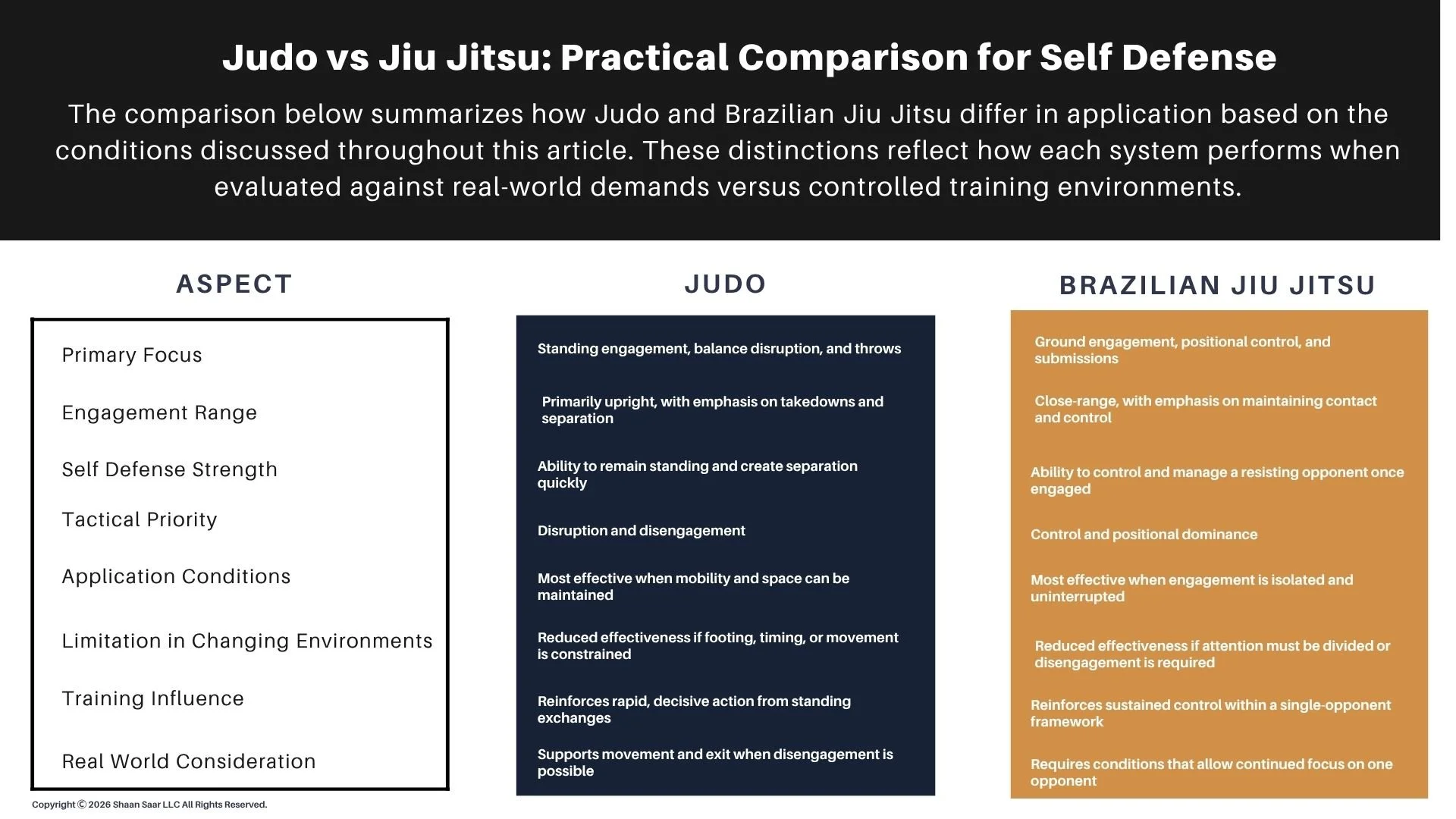
Judo vs Jiu Jitsu: Practical Comparison for Self Defense
Why the Judo vs Jiu Jitsu Comparison Is Limited
Comparisons such as Judo vs Jiu Jitsu are often framed as a question of effectiveness, as if one system provides a more complete solution to self defense than the other. That framing assumes that the primary variable is the system itself. The preceding analysis suggests otherwise.
Both systems are built within structured training environments that shape how behavior is developed and expressed. The differences between them. whether standing engagement or ground control, reflect different solutions to the same underlying constraint, that is, how-to manage a resisting opponent under defined conditions. Within those conditions, both systems can be highly effective.
The limitation emerges when those conditions change. As environmental demands increase, performance is influenced less by the specific techniques of a given system and more by how well the practitioner can adapt to competing demands. Motor learning research indicates that learned behaviors do not always transfer reliably across contexts, particularly when the structure of the environment differs from the conditions under which the skill was acquired (Müssgens & Ullén, 2015).
At the same time, attention must be allocated across multiple sources of information, placing limits on how effectively complex actions can be executed under pressure (Pashler et al., 2001). These constraints apply regardless of the system being used. They are properties of human performance, not characteristics of a particular style.
This is why the comparison itself becomes limited. It treats systems as isolated variables, when in practice they operate within broader constraints which shape how and when they can be applied. A technique that is effective in one context may not be available in another, not because it is flawed, but because the conditions required for its use are no longer present.
The more relevant question is not which system is better, rather which behaviors remain functional as conditions change. This requires shifting the focus away from style and toward the interaction between the individual, the environment, and the task. From that perspective, the differences between systems become secondary to the conditions under which performance must occur.
This shift in perspective forms the basis for how self defense must be evaluated when the goal is performance under real-world conditions.
SECTION SUMMARY
The comparison of Judo vs Jiu Jitsu is limited because it isolates systems from the conditions that determine performance. Both are effective within structured environments, but real-world self defense is shaped by changing demands on attention, movement, and decision-making. When those conditions shift, effectiveness is no longer determined by style, but by whether behavior remains functional under pressure.
How This Connects to Real World Self Defense
The implications of this analysis extend beyond stylistic comparison. In real-world self defense, the defining variable is not the system being used, but whether the practitioner can continue to function as conditions change.
This becomes particularly relevant in environments where the interaction is no longer isolated. As additional variables enter the situation, whether through environmental constraints, competing demands, or the presence of more than one threat, the assumptions that support controlled engagement begin to break down. Under these conditions, the ability to remain mobile, maintain awareness, and adjust behavior in real time becomes more important than sustaining control over a single opponent.
This dynamic is examined in greater detail in our breakdown of how grappling performs in multi-attacker environments, where sustained engagement becomes increasingly difficult as attentional and movement demands increase. That analysis highlights how quickly the cost of committing to one interaction rises when the environment no longer permits sequential engagement.
It also connects to the broader question of how training translates into performance. As discussed in our examination of how Brazilian Jiu Jitsu functions in real-world encounters, the effectiveness of any system is conditional. It depends on whether the environment allows the practitioner to apply what they have learned without competing demands disrupting execution.
Taken together, these points reinforce a consistent pattern. Real-world self defense is defined by instability. Performance is shaped by how well an individual can manage changing conditions, not by how effectively they can execute techniques in isolation.
SECTION SUMMARY
Real-world self defense is shaped by whether behavior remains functional as conditions change. As environmental demands increase and interactions become less predictable, the assumptions that support controlled engagement begin to break down. Effectiveness depends upon the ability to maintain mobility, awareness, and adaptability under competing demands, while avoiding prolonged commitment to a single opponent.
Evidence-Based Self Defense™
Evidence-Based Self Defense™ is not defined by a fixed set of techniques. It is a framework for understanding how performance is shaped by the conditions under which it must occur.
The analysis throughout this article reflects that framework. It does not evaluate systems in isolation. It examines how behavior emerges when the individual, the task, and the environment interact under pressure.
From this perspective, effectiveness is not determined by stylistic preference or technical depth alone. It is determined by whether actions remain functional as conditions change. This includes the ability to perceive relevant information, allocate attention under competing demands, and adapt movement in response to environmental instability.
The preceding sections illustrate how training environments shape behavior, how rule structures influence decision-making, and how cognitive and physiological constraints limit performance under load. These are not separate factors. They are interacting variables that determine whether a response can be executed when it matters.
Within this framework, the goal of self defense training is not simply to develop technique, but to ensure that technique remains available under changing conditions. This requires accounting for variability, attentional demands, and the limits of human performance, rather than assuming that skills developed in controlled environments will transfer unchanged into real-world situations.
This is the distinction that defines Evidence-Based Self Defense™. It is organized around the variables that determine whether any method can be applied when the environment does not remain stable. When performance is evaluated through this lens, the question is no longer which system is preferred, but whether behavior remains adaptable as conditions change.
References
Davids, K., Button, C., & Bennett, S. (2008). Dynamics of skill acquisition: A constraints-led approach. Human Kinetics.
Eysenck, M. W., Derakshan, N., Santos, R., & Calvo, M. G. (2007). Anxiety and cognitive performance: Attentional control theory. Emotion (Washington, D.C.), 7(2), 336–353. https://doi.org/10.1037/1528-3542.7.2.336
McPhee, A. M., Cheung, T. C. K., & Schmuckler, M. A. (2022). Dual-task interference as a function of varying motor and cognitive demands. Frontiers in Psychology, 13, 952245. https://www.frontiersin.org/journals/psychology/articles/10.3389/fpsyg.2022.952245/full
Müssgens, D. M., & Ullén, F. (2015). Transfer in motor sequence learning: Effects of practice schedule and sequence context. Frontiers in Human Neuroscience, 9, 642. https://doi.org/10.3389/fnhum.2015.00642
Pashler, H., Johnston, J. C., & Ruthruff, E. (2001). Attention and performance. Annual Review of Psychology, 52, 629–651. https://doi.org/10.1146/annurev.psych.52.1.629
Stergiou, M., Robles-Pérez, J. J., Rey-Mota, J., Tornero-Aguilera, J. F., & Clemente-Suárez, V. J. (2023). Psychophysiological responses in soldiers during close combat: Implications for occupational health and fitness in tactical populations. Healthcare (Basel), 12(1), 82. https://doi.org/10.3390/healthcare12010082
Warren, W. H. (2006). The dynamics of perception and action. Psychological Review, 113(2), 358–389. https://doi.org/10.1037/0033-295X.113.2.358

ABOUT THE AUTHOR
Renée Rose is a Medicolegal Consultant, Forensic Crime Analyst, and creator of the Trauma Informed Self-Defense™ framework. Her work integrates clinical forensic psychological education and research with Evidence-based self defense focusing on skill acquisition under stress and how judgment and decision-making function under stress in real-world contexts.
Copyright and Intellectual Property Notice
© 2026 Shaan Saar Krav Maga Orlando. All rights reserved.
Trauma-Informed Self Defense™, Evidence-Based Self Defense™, Transform Fear™, and all related training methodologies, frameworks, course structures, terminology, and instructional materials referenced herein are proprietary intellectual property of Shaan Saar LLC.
No portion of this publication may be reproduced, distributed, transmitted, adapted, or otherwise used for commercial or instructional purposes without express written permission. Informational citation with proper attribution is permitted; replication of methodology, sequencing, instructional design, or training structure is prohibited.